 By Raghav Sharma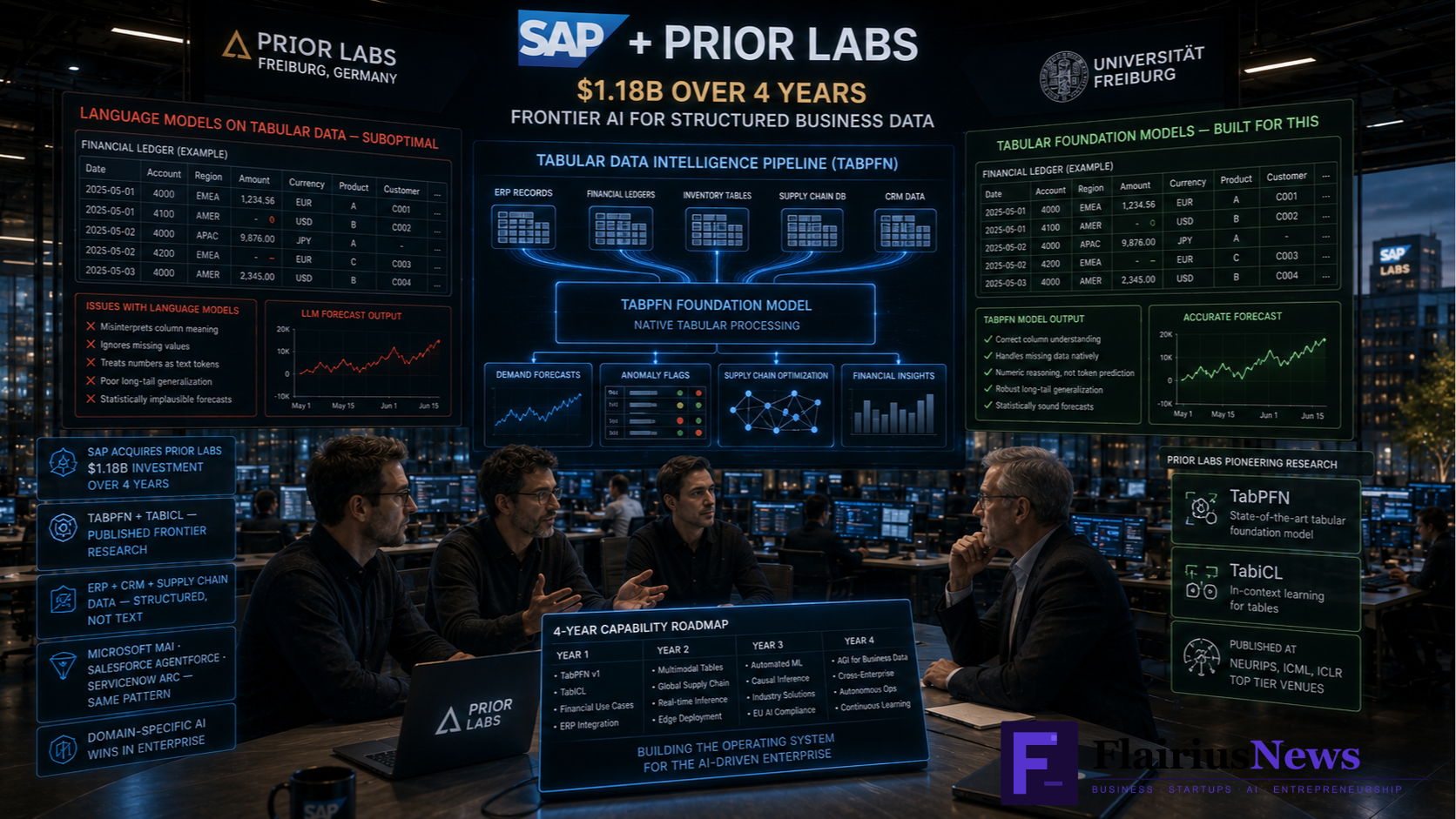
Enterprise software companies have spent the last three years adding AI features. Now, one of the most important enterprise software companies in the world has decided that is not enough.
SAP announced it will acquire Prior Labs a Freiburg, Germany-based startup developing tabular foundation models and invest more than $1.18 billion over four years to transform it into a globally leading frontier AI research lab. Moreover, this is not an AI product acquisition. Specifically, SAP is building an in-house frontier AI research capability from scratch, focused on a type of AI that no frontier lab has yet fully solved: structured business data prediction.
The deal, pending regulatory approval, signals a fundamental shift in how enterprise software incumbents are approaching AI. Specifically, they are no longer content to be distribution layers for OpenAI, Anthropic, or Google models. Instead, they are building models that understand their proprietary data and their customers’ proprietary data better than any general-purpose frontier lab can.
What Prior Labs Builds and Why It Matters
Prior Labs is the creator of TabPFN and TabICL tabular foundation models specifically designed to process structured, table-formatted business data. Moreover, this is the data type that defines enterprise software. Specifically, ERP systems, financial ledgers, inventory tables, HR records, supply chain databases, and CRM pipelines all consist primarily of structured tabular data not the natural language text on which most frontier AI models are trained.
Furthermore, the technical challenge Prior Labs addresses is distinct from general language modelling. Specifically, tabular data has different statistical properties, different missing-data patterns, different categorical encoding requirements, and different feature interaction structures than text. Therefore, applying a language model to tabular business data as many enterprise AI products currently do produces suboptimal results. Prior Labs’ tabular foundation models are designed to handle this data type natively.
Additionally, Prior Labs’ academic credentials are strong. Specifically, the team is led by researchers from the University of Freiburg one of Europe’s leading AI research institutions with published work that has been cited extensively in the machine learning community. Therefore, SAP is not acquiring a startup with a promising product demo. It is acquiring a research team with proven technical depth in a specific, high-value problem domain.
Why SAP Is Building, Not Buying, a Model
SAP’s decision to invest $1.18 billion over four years rather than simply licensing OpenAI or Anthropic models reflects a specific strategic logic. First, SAP’s enterprise customers share extraordinarily sensitive business data with SAP systems. Specifically, ERP deployments contain pricing structures, supplier contracts, workforce compositions, and financial forecasts that no enterprise would be comfortable sharing with a third-party model provider. Therefore, an in-house model that trains on SAP’s proprietary data with full control over the training pipeline is a compliance and competitive advantage, not just a technical preference.
Second, the structured data problem is genuinely underserved. Specifically, the frontier AI labs Anthropic, OpenAI, Google DeepMind have focused their research on language reasoning, coding, and multimodal capabilities. Moreover, their models perform well on text-based enterprise tasks. However, for structured prediction tasks demand forecasting, financial anomaly detection, supply chain optimisation, and HR attrition modelling tabular foundation models outperform language models by a significant margin. Consequently, SAP is targeting a capability gap that exists precisely because the frontier labs have not prioritised it.
Third, the timeline is right. Specifically, the $1.18 billion investment over four years gives Prior Labs the resources to build frontier-scale tabular AI capabilities while remaining integrated with SAP’s product roadmap. Furthermore, by establishing the lab in Freiburg, SAP retains access to European AI research talent a strategic advantage as competition for frontier AI researchers intensifies globally.
What This Means for the Enterprise AI Landscape
SAP’s Prior Labs acquisition is part of a broader pattern redefining enterprise AI in 2026. Specifically, Microsoft built its MAI model family at Build 2026. Moreover, Salesforce is deepening its Agentforce platform with proprietary model development. Additionally, ServiceNow and NVIDIA launched Project Arc for enterprise autonomous agents at ServiceNow Knowledge 2026. Consequently, the enterprise AI market of 2026 is not a market where one frontier lab provides the model and all others distribute it. It is a market where every major enterprise software company is building proprietary AI capabilities tailored to its specific data and customer base.
Furthermore, this fragmentation creates a meaningful opportunity. Specifically, enterprise AI buyers in 2026 will increasingly compare not just which AI is most capable in general, but which AI understands their specific industry, their specific data structure, and their specific compliance requirements. Therefore, SAP’s bet on structured business data AI is a bet that domain specificity will be the defining enterprise AI advantage of the next decade and Prior Labs gives SAP a credible claim to that position.
Tags: SAP Prior Labs Acquisition, SAP $1.18B Frontier AI Lab, Tabular Foundation Models, Enterprise AI 2026, Prior Labs TabPFN, SAP AI Strategy, Structured Data AI, Enterprise Software AI Lab, SAP AI Freiburg Germany, In-House AI Enterprise 2026 Author CTA: Follow Flairius News — sharp takes on AI, business, and India’s startup economy — flairiusnews.com
 Ahana Verma
  Aditya Agarwal