
 By Nayra Roy
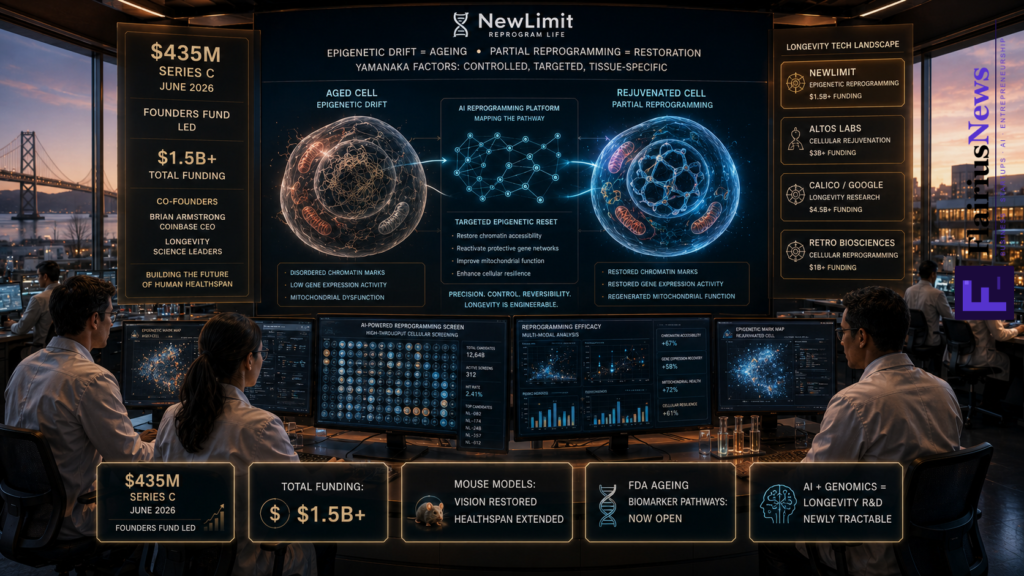
Most startup categories promise to make work faster, cheaper, or more efficient. NewLimit is trying to do something categorically different. Specifically, it is trying to make human beings biologically younger and it just raised $435 million to do so.
On June 2, 2026, NewLimit closed a Series C round led by Founders Fund Peter Thiel’s venture firm, which has a well-established pattern of backing companies working on civilisational-scale problems. Specifically, the round brings NewLimit’s total reported funding to at least $1.5 billion, making it one of the most heavily funded longevity biotechnology companies in the world. Moreover, the company was co-founded by Coinbase CEO Brian Armstrong alongside David Sinclair-affiliated researchers combining Silicon Valley capital credibility with serious longevity science.
NewLimit’s core mission is epigenetic reprogramming developing medicines that restore youthful gene expression patterns in old cells. Specifically, the company is not targeting a single disease. Instead, it is targeting the underlying biological mechanism of ageing itself the progressive loss of epigenetic information that causes cells to lose their identity, function, and regenerative capacity over time.
What Epigenetic Reprogramming Actually Is
To understand NewLimit’s approach, it helps to understand what epigenetics means in practical terms. Specifically, every cell in the human body contains identical DNA the same genetic sequence regardless of whether the cell is a neuron, a liver cell, or a cardiac muscle fibre. Moreover, what makes cells different is not the DNA itself but the epigenetic programme that controls which genes are expressed and which are silenced in each cell type.
Ageing disrupts this epigenetic programme. Specifically, over time, the chemical marks that tell cells which genes to activate or suppress become increasingly disordered a process sometimes called epigenetic drift. Furthermore, as the programme degrades, cells begin to lose function: they repair damage more slowly, respond less effectively to stress, and gradually transition from healthy function toward the dysfunctional states associated with age-related disease.
Epigenetic reprogramming aims to reset this programme restoring the precise chemical marks that characterised the cell’s youthful gene expression pattern. Specifically, Shinya Yamanaka’s Nobel Prize-winning work demonstrated that introducing specific transcription factors known as Yamanaka factors could reprogram adult cells back to a stem cell-like state. Moreover, partial reprogramming using a subset of these factors for a controlled period appears capable of restoring youthful epigenetic marks without fully erasing the cell’s identity.
NewLimit’s platform applies this principle at therapeutic scale. Specifically, the company uses AI-powered genomics and high-throughput cellular screening to identify the optimal reprogramming targets and delivery approaches for specific tissue types and age-related conditions.
Why $435 Million at This Stage
The size of NewLimit’s Series C reflects both the ambition of the problem and the maturing credibility of epigenetic reprogramming as a therapeutic strategy. Specifically, the research base has strengthened significantly since 2022 with multiple peer-reviewed studies demonstrating partial reprogramming’s ability to restore cellular function in aged tissues, improve vision in aged mice, and extend healthspan in animal models.
Furthermore, Founders Fund’s decision to lead the round is a specific signal. Specifically, Founders Fund consistently backs companies addressing what Thiel calls “secrets” important things that most intelligent people believe are impossible or impractical, but that a small number of researchers believe are achievable with sufficient capital and talent. Therefore, the lead investor’s conviction communicates that NewLimit’s scientific approach has crossed the credibility threshold from speculative to technically grounded.
Moreover, the competitive landscape is accelerating. Specifically, Altos Labs, Calico (Google’s longevity company), and a growing cohort of well-funded longevity startups are all pursuing different angles on the same biological problem. Consequently, the $435 million gives NewLimit the capital to move quickly enough to establish the lead in epigenetic reprogramming before the field becomes crowded with well-capitalised competitors.
What the Longevity Tech Boom Means for 2026
NewLimit sits within a broader longevity biotechnology investment surge that is one of 2026’s most striking venture capital trends. Specifically, the category has attracted significant capital from technology billionaires Jeff Bezos, Larry Ellison, Brian Armstrong, and others who treat longevity research as a personal priority as much as an investment thesis. Moreover, the AI capabilities available for drug discovery in 2026 protein structure prediction, generative molecular design, and high-throughput cell screening have made longevity research significantly more tractable than it was five years ago.
Furthermore, the regulatory environment is slowly evolving. Specifically, the FDA’s Accelerating Medicines Partnership has opened pathways for ageing-related biomarkers to be used as clinical trial endpoints removing one of the most significant barriers to longevity drug development. Therefore, companies like NewLimit now have a clearer regulatory path to clinical validation than any longevity startup faced before 2024.
Therefore, NewLimit’s $435 million is not simply a bet on one company. It is a signal that the capital markets have started treating the biology of ageing as a solvable engineering problem — not a philosophical constant.
Tags: NewLimit, $435M Series C, Founders Fund Longevity, Epigenetic Reprogramming Medicine, Brian Armstrong NewLimit, Longevity Biotech 2026, Ageing Reversal Startup, Yamanaka Factors Reprogramming, Longevity Tech Funding, Altos Labs Competitor 2026 Author CTA: Follow Flairius News — sharp takes on AI, business, and India’s startup economy — flairiusnews.com
 Ahana Verma