
 By Nayra Roy
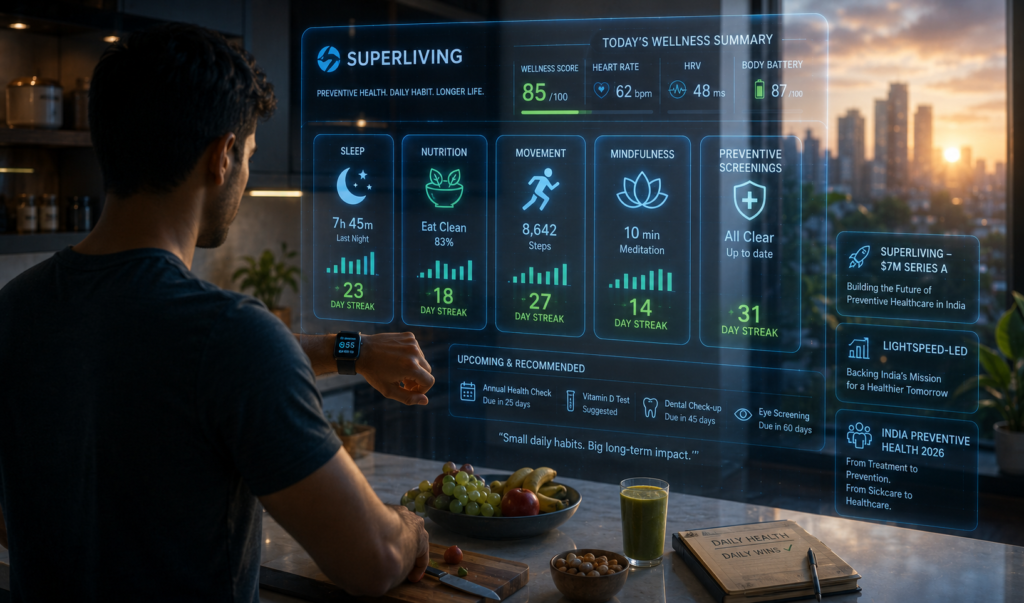
Most healthcare startups in India focus on treating illness after it appears. SuperLiving is betting investors will pay attention to a less dramatic but potentially more valuable problem: keeping people from getting sick in the first place.
On June 25, 2026, Bengaluru-based preventive lifestyle platform SuperLiving raised $7 million in a Series A led by Lightspeed. Moreover, existing investors Kae Capital and All In Capital also participated, signalling continued confidence from backers who already know the company’s trajectory closely.
Why Preventive Health Is a Harder Sell, But a Bigger Prize
Reactive healthcare treating an illness once it appears has an obvious, urgent value proposition that is easy for consumers to understand and pay for. However, preventive healthcare asks people to spend money and effort today against a risk that might never materialise. Specifically, that makes consumer adoption harder to drive, even though the long-term value to both individuals and the healthcare system is often larger.
Therefore, SuperLiving’s challenge is fundamentally a behavioural one, not just a product one: convincing Indian consumers that daily preventive habits are worth paying for consistently, not just during a health scare.
What Makes Lightspeed’s Lead Notable
Lightspeed has backed numerous consumer and healthtech companies globally, giving it meaningful pattern recognition for what makes preventive and wellness platforms actually stick with users long-term. Consequently, its decision to lead this round suggests SuperLiving has demonstrated retention and habit-formation metrics strong enough to justify confidence in the harder, preventive-health sales motion.
Moreover, India’s growing middle class has shown increasing willingness to spend on wellness, fitness, and health-tracking products over recent years. Therefore, SuperLiving sits at the intersection of rising consumer health awareness and improving digital health infrastructure.
The Bigger Healthtech Pattern in India
India’s healthtech sector has diversified well beyond telemedicine and diagnostics over the past few years. Specifically, wellness, mental health, fitness, and now preventive lifestyle platforms have each carved out distinct investor attention. Furthermore, this diversification mirrors a broader 2026 trend across Indian startup funding: capital increasingly flows into specific, well-defined consumer health niches rather than broad, undifferentiated health-app platforms.
Consequently, SuperLiving’s positioning as specifically preventive, rather than general wellness, may give it a clearer story to tell both consumers and future investors as it scales.
What the Capital Will Fund
SuperLiving is expected to use the Series A funding to deepen its preventive health product offerings and expand its user base across Indian cities. Furthermore, building genuine daily habits around preventive health requires sustained user engagement infrastructure, which likely represents a significant portion of where this capital gets deployed.
Therefore, SuperLiving’s progress over the coming months will offer a useful signal for whether Indian consumers are genuinely ready to pay for prevention, not just treatment.
Tags: SuperLiving Funding, Lightspeed India Investment, India Preventive Healthcare 2026, India Wellness Startup, India Healthtech Funding, Kae Capital India, India Consumer Health Habits Author CTA: Follow Flairius News — sharp takes on AI, business, and India’s startup economy — flairiusnews.com
 Raghav Sharma