 By Nayra Roy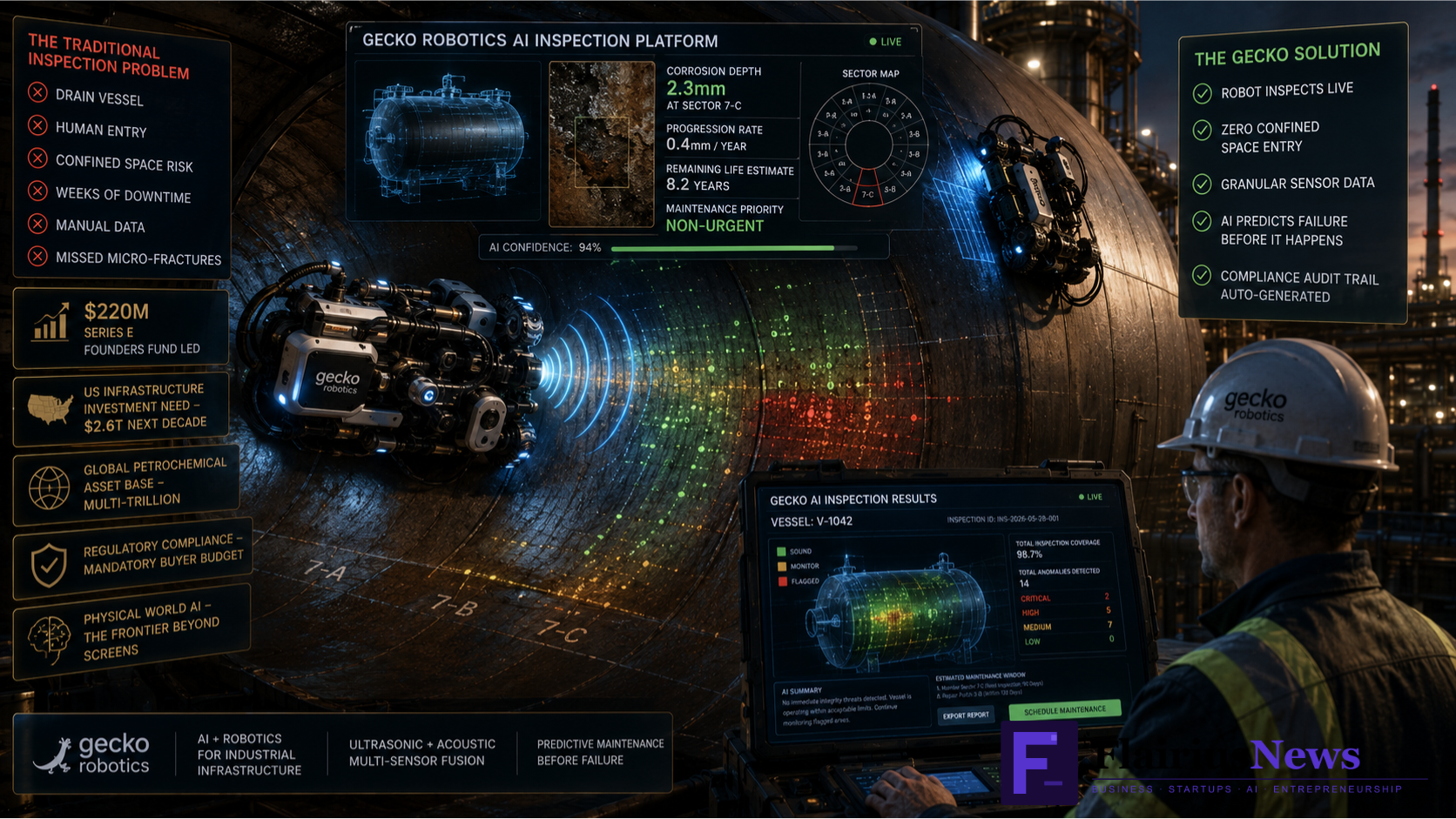
While most AI startup coverage focuses on chatbots, code generators, and content tools, one of 2026’s most consequential AI applications is happening in a far less glamorous location the inside of a pipeline, the surface of a storage tank, and the structure of a bridge.
Gecko Robotics raised $220 million in a Series E led by Founders Fund Peter Thiel’s venture firm to expand its AI-powered robotic inspection platform. Specifically, Gecko builds robots that physically crawl across industrial infrastructure power plants, petrochemical facilities, water treatment systems, bridges, and industrial vessels collecting inspection data that its AI then analyses to identify structural risks, predict failures, and prioritise maintenance.
Furthermore, the company is one of the most watched in AI robotics precisely because it operates at the intersection of two urgent realities: global infrastructure is ageing rapidly, and the cost of infrastructure failure measured in human lives, economic disruption, and environmental damage is catastrophically high.
What Gecko Robotics Does and Why It Matters
Traditional infrastructure inspection is slow, expensive, and dangerous. Specifically, a standard inspection of a large industrial vessel requires draining the vessel, sending human inspectors inside with measurement equipment, and compiling thousands of data points manually. Moreover, this process takes weeks, exposes workers to confined-space risks, and generates data that is difficult to compare across inspection cycles. Consequently, many critical infrastructure assets are under-inspected not because operators do not care, but because inspection is genuinely difficult at scale.
Gecko’s robots change this equation. Specifically, they are magnetic and can adhere to and traverse steel surfaces both internal and external without human entry. Furthermore, they carry ultrasonic, acoustic, and visual sensors that collect far more granular data than a human inspector with manual tools. Moreover, Gecko’s AI platform processes that data to generate structural condition maps, corrosion progression models, and failure probability estimates that enable predictive maintenance rather than scheduled replacement. Consequently, operators can prioritise which sections of infrastructure need immediate attention and which can continue operating safely.
Additionally, the economic case is compelling. Specifically, Gecko’s customers save money by extending the operational life of assets that preventive AI inspection confirms are safe, while avoiding catastrophic failure costs that undetected structural problems generate. Furthermore, regulatory compliance for industrial inspection is mandatory meaning Gecko’s platform creates a compliance-grade audit trail as a byproduct of every inspection. Therefore, the buyer already has a budget for inspection. Gecko makes that budget work dramatically harder.
Why Founders Fund Led This Round
Founders Fund’s investment thesis is distinctive. Specifically, the firm consistently backs companies working on what Peter Thiel calls “hard technology” physical world problems that software alone cannot solve. Moreover, Gecko fits this thesis precisely: it requires advanced robotics hardware, AI software, industrial engineering expertise, and safety certification a combination that creates barriers to entry that pure software companies cannot overcome.
Furthermore, infrastructure inspection sits at a scale that justifies the attention. Specifically, the American Society of Civil Engineers estimates that the US alone has more than $2.6 trillion in infrastructure investment needs over the next decade. Moreover, petrochemical and power generation infrastructure globally represents a multi-trillion-dollar asset base that requires continuous inspection. Consequently, Gecko’s total addressable market is not a narrow vertical it is the physical infrastructure of the entire global economy.
What Industrial AI Represents for 2026
Gecko Robotics represents a broader trend that is defining 2026’s startup funding landscape. Specifically, AI is moving off the screen and into the physical world into robots, sensors, manufacturing systems, and inspection platforms that operate in environments where software alone is insufficient.
Furthermore, industrial AI companies share several properties that make them particularly attractive in 2026’s funding environment. First, the buyer is clear and has a defined budget. Second, the ROI is quantifiable fewer failures, fewer shutdowns, fewer human inspection risks. Third, the regulatory requirement creates durable demand. Therefore, industrial AI is not subject to the adoption uncertainty that haunts many consumer AI categories.
Gecko Robotics is not the AI story you read about every day. However, it may be the AI story that matters most when the next infrastructure failure is prevented because an AI-powered robot found the crack before it became a catastrophe.
Tags: Gecko Robotics, $220M Series E, Founders Fund, Industrial AI 2026, Infrastructure Inspection AI, AI Robotics Startup, Physical World AI, Infrastructure Maintenance AI, Peter Thiel AI Investment, Deep Tech Startup 2026 Author CTA: Follow Flairius News — sharp takes on AI, business, and India’s startup economy — flairiusnews.com
 Ahana Verma