
 By Ahana Verma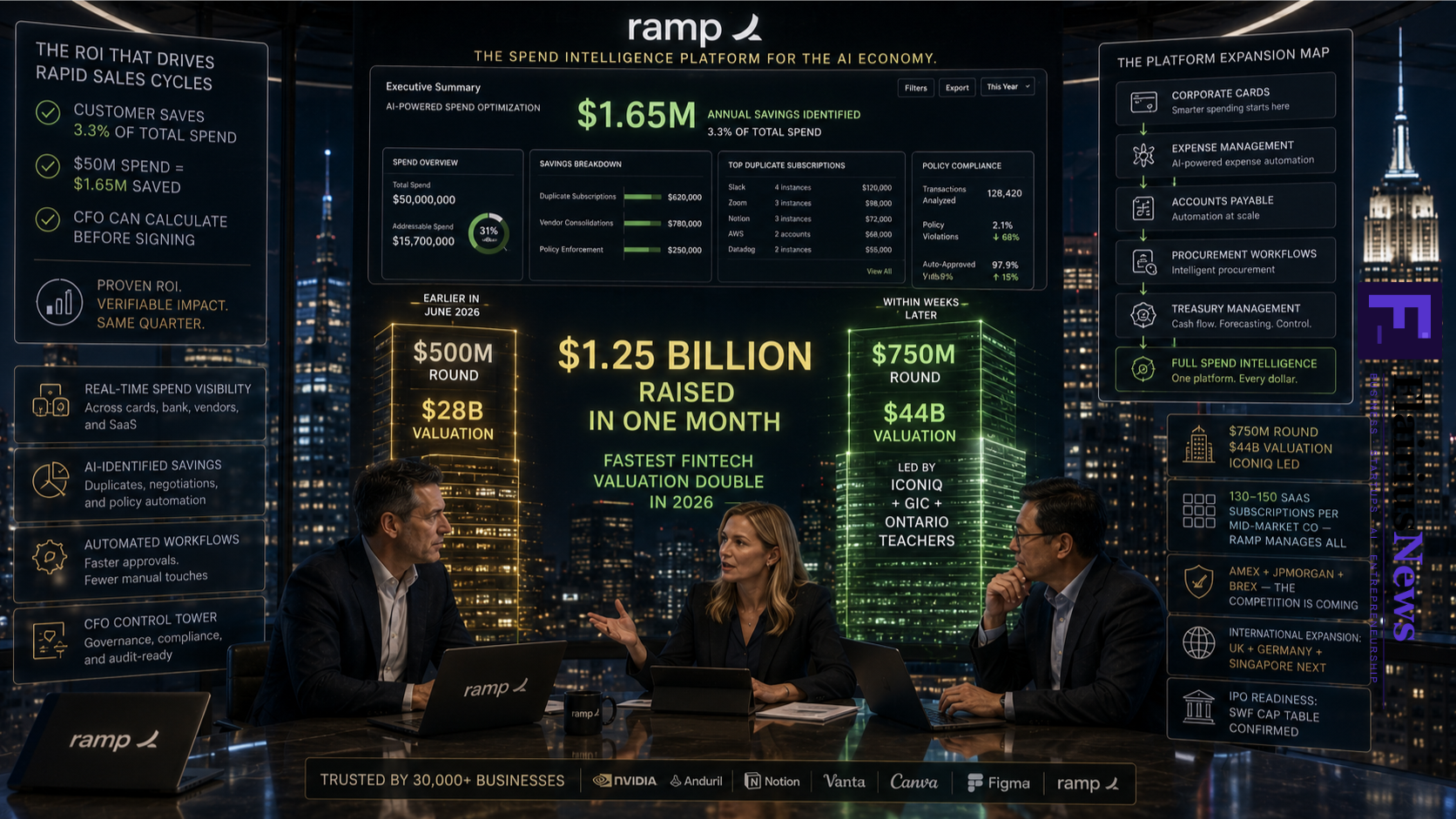
Less than two weeks after closing a $500 million round, Ramp returned to the market and raised $750 million more. Furthermore, it did so at a $44 billion valuation nearly doubling from the $28 billion it carried just months earlier.
The latest round, led by Iconiq with participation from GIC and Ontario Teachers’ Pension Plan, confirms what the market has been signalling for several months: AI-powered spend management is not a feature on a corporate card. Moreover, it is a platform and Ramp is executing a category land-grab in the narrow window before enterprise incumbents close the gap.
The combined $1.25 billion raised across two consecutive rounds in June 2026 makes Ramp one of the most capitalised fintech startups in the world. Specifically, it now has the runway to accelerate international expansion, deepen its AI capability, and build the enterprise sales infrastructure needed to compete at Fortune 500 scale. Furthermore, the investor quality signals confidence: Iconiq manages capital for some of the world’s wealthiest technology executives, and GIC is Singapore’s sovereign wealth fund investors who validate Ramp’s institutional credibility as much as its financial prospects.
What Ramp Has Proved Since Its Last Round
The speed of Ramp’s second round is itself a story. Specifically, $750 million raised within weeks of a $500 million close at a valuation nearly double the previous reflects real commercial momentum, not simply investor enthusiasm. Moreover, Ramp’s core product metrics continue to validate the investment.
Specifically, the company’s AI spend management platform has demonstrated that customers save an average of 3.3% of total spend compared to traditional corporate card programmes. Furthermore, for a mid-market company spending $50 million annually, that translates to $1.65 million in direct annual savings a number that any CFO can calculate, defend to a board, and use to justify procurement without a lengthy approval process. Consequently, Ramp’s sales cycle is unusually short for an enterprise software company because the ROI arrives before the contract is even signed.
Additionally, Ramp has expanded its product significantly beyond expense management. Specifically, the platform now covers corporate cards, accounts payable automation, procurement workflows, real-time budget tracking, and a treasury management layer. Therefore, a company that starts with Ramp for expense reimbursement often expands to Ramp for AP automation and then for full spend intelligence creating a land-and-expand dynamic that builds revenue without requiring new customer acquisition.
What $44 Billion Reflects About the Category
Ramp’s $44 billion valuation is not simply a bet on one company. Specifically, it is a bet on the entire enterprise spend management category reaching a scale that justifies platform-level multiples. Moreover, the supporting evidence is structural.
First, corporate spending is growing in complexity. Specifically, the average mid-market company now manages 130 to 150 SaaS subscriptions, dozens of vendor relationships, and multi-currency operations creating a reconciliation and compliance burden that manual processes cannot sustain. Therefore, AI that handles this complexity automatically is a system of record, not a productivity tool.
Second, the regulatory environment is adding pressure. Specifically, CFOs in 2026 face more frequent audit requirements, stricter expense documentation standards, and increased scrutiny on vendor consolidation. Moreover, Ramp’s AI-generated audit trails and automated policy enforcement reduce the human effort required for compliance creating a compliance advantage that legacy expense tools cannot easily replicate.
Third, the competitive window is narrowing. Specifically, American Express, JP Morgan, and Citi are all building AI spend management features into their existing corporate card products. Furthermore, Brex is targeting enterprise accounts with increasing aggressiveness. Consequently, the $750 million gives Ramp the capital it needs to execute a category dominance strategy before incumbents close the feature gap.
What Comes Next for Ramp
The most likely use of the $750 million is threefold. First, accelerating international expansion particularly into the UK, Germany, and Singapore markets where enterprise demand for AI spend management is highest outside the US. Second, deepening the AI capability toward fully autonomous spend recommendations where the system not only flags anomalies but executes approved optimisations without human intervention. Third, building enterprise sales infrastructure at the scale needed to close Fortune 500 contracts where procurement cycles are longer and decision-making is more complex.
Furthermore, an IPO is increasingly the logical next step. Specifically, at $44 billion in private valuation and with institutional sovereign wealth fund investors now on the cap table, Ramp has the revenue, the governance structure, and the investor profile to support a public listing. The $3 trillion IPO supercycle that Anthropic, SpaceX, and OpenAI are leading in 2026 creates a favourable public market window that Ramp would be well-positioned to enter.
Tags: Ramp $750M, Ramp $44B Valuation, Iconiq Ramp, AI Spend Management 2026, Ramp Fintech Funding, Enterprise AI Fintech, Ramp vs Brex 2026, Corporate Finance AI, GIC Ontario Teachers Ramp, Ramp IPO 2026 Author CTA: Follow Flairius News — sharp takes on AI, business, and India’s startup economy — flairiusnews.com
 Aditya Agarwal