
 By Raghav Sharma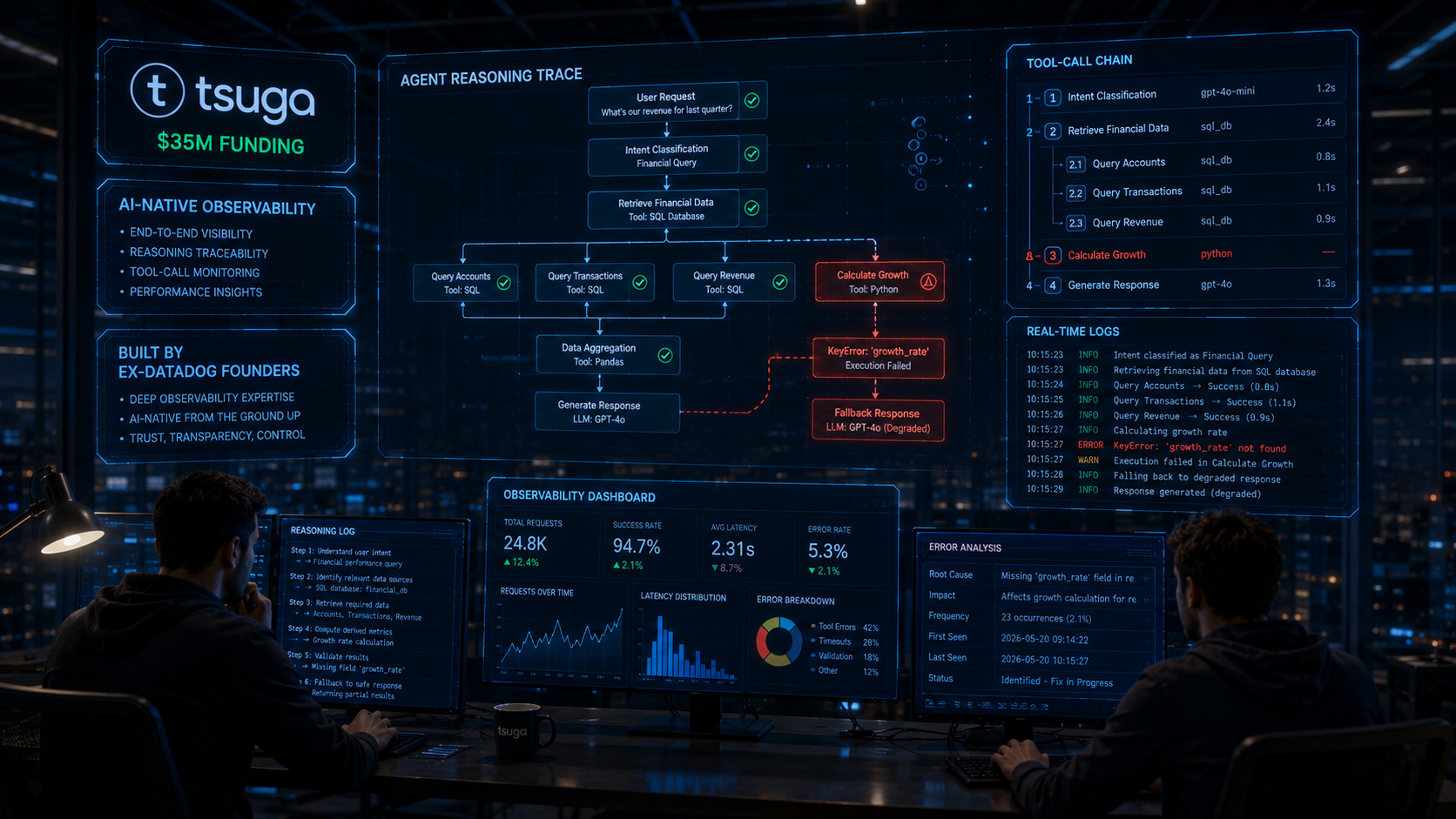
Selling your company to a giant in your category usually means you are done competing in it. The founders behind Tsuga apparently disagree.
On June 23, 2026, Tsuga founded by engineers who previously sold their startup to Datadog raised $35 million to build AI-native observability tools. Moreover, the round bets that the entire observability category needs rebuilding from scratch for a world dominated by autonomous AI agents, not just traditional software monitoring.
Why Observability Needs Rebuilding for AI Agents
Traditional observability tools were built to monitor predictable, deterministic software systems. Specifically, they track logs, metrics, and traces generated by code that behaves consistently every time it runs. However, AI agents do not behave deterministically the same prompt can produce different reasoning paths, different tool calls, and different outcomes across runs.
Consequently, monitoring agentic systems requires fundamentally different infrastructure. Therefore, founders with deep observability expertise exactly the kind Tsuga’s team has from their Datadog years are uniquely positioned to identify what breaks when agents fail and why.
The Bet Behind the Round
As enterprises deploy more autonomous AI agents into production workflows, debugging failures becomes a serious operational risk. Furthermore, when an agent makes a wrong decision in a customer-facing workflow, engineering teams need to trace exactly which reasoning step caused it something traditional monitoring tools were never designed to do.
Specifically, this creates an entirely new product category: AI-native observability built around reasoning traces, tool-call chains, and agent decision paths rather than simple request-response logs. Moreover, investors clearly believe this category will become as essential to enterprise AI deployment as traditional observability became to cloud computing.
What Comes Next
Tsuga is expected to use the funding to build out its core monitoring infrastructure and pursue early enterprise design partners deploying agentic systems at scale. Furthermore, the founders’ prior exit gives them credibility with enterprise buyers who already trust their judgment on observability problems.
Therefore, watch this category closely through the rest of 2026. Specifically, as agentic AI adoption accelerates across enterprise workflows, AI-native observability looks set to become one of the more important if less glamorous infrastructure layers underneath the entire AI stack.
Tags: Tsuga Funding, AI Observability 2026, Ex-Datadog Founders, Agentic AI Infrastructure, Enterprise AI Monitoring, AI-Native Tools, AI Infrastructure Funding 2026 Author CTA: Follow Flairius News — sharp takes on AI, business, and India’s startup economy — flairiusnews.com
 Nayra Roy
  Aditya Agarwal