
 By Ahana Verma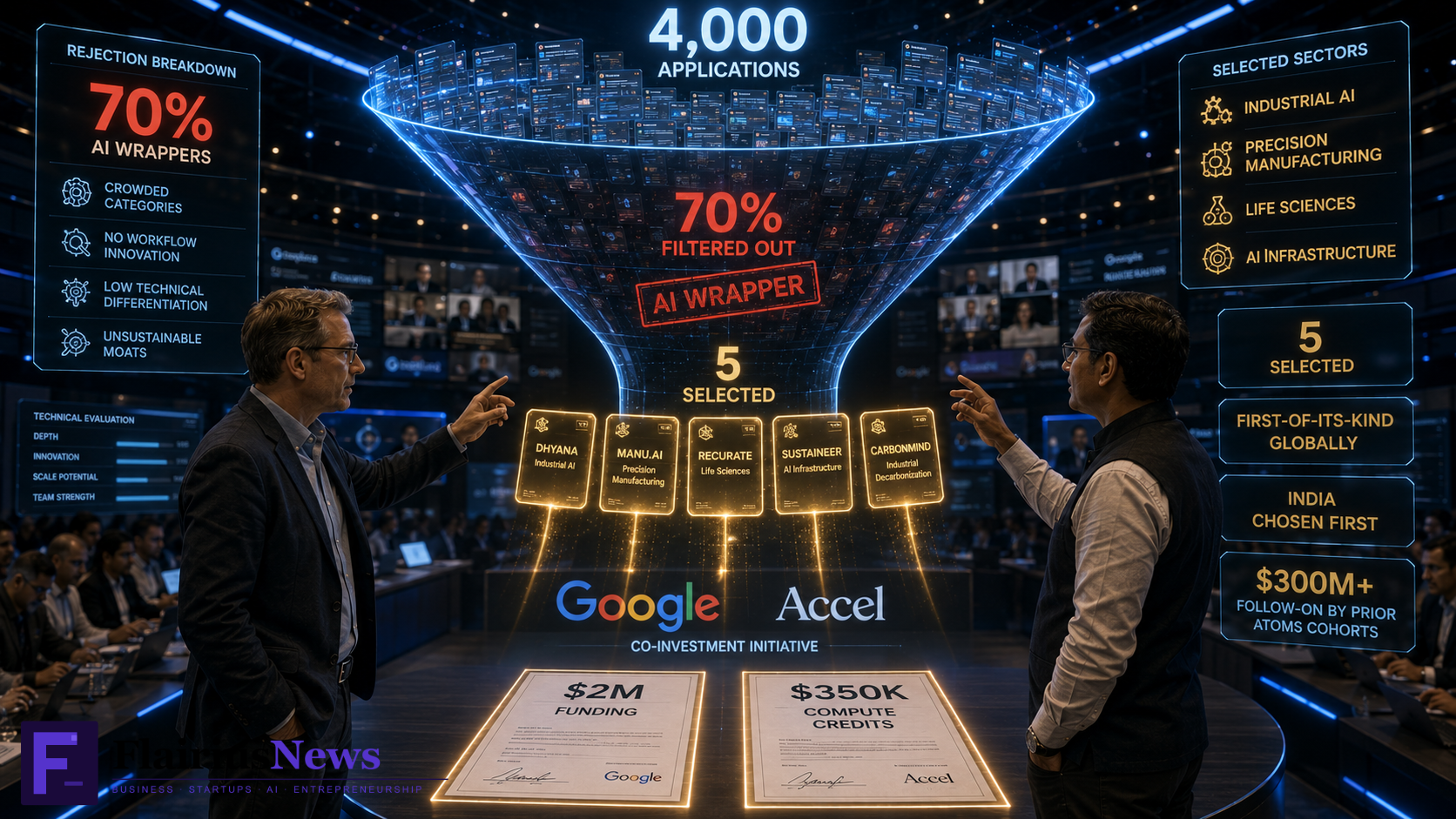
Four thousand Indian AI startups applied. Only five were selected. Moreover, the most common reason for rejection was not poor execution or weak founders. It was building the wrong kind of AI entirely.
That is the outcome of the Atoms AI Cohort 2026 a first-of-its-kind partnership between Google’s AI Futures Fund and Accel, announced in November 2025 and revealed in March 2026. Together, the two firms will co-invest up to $2 million in each selected startup. Furthermore, each chosen company receives up to $350,000 in compute credits across Google Cloud, Gemini, and DeepMind. Additionally, selected founders get direct, sustained guidance from senior technical experts at Google and DeepMind.
However, the rejection data is where the real insight lives.
The Wrapper Problem India Needs to Solve
Prayank Swaroop, partner at Accel, was direct about what the selection process revealed. Approximately 70% of rejected applications were what he called “wrappers” startups that layered AI features such as chatbots on top of existing software but were not reimagining new workflows using AI.
This is a critical distinction. Furthermore, it reflects a broader pattern in India’s AI startup landscape. Many founders are building with AI. However, fewer are building AI infrastructure, new AI-native workflows, or genuinely novel applications of AI that could not exist without the underlying technology.
Additionally, many of the remaining rejected applications fell into crowded categories marketing automation and AI recruitment tools where investors saw little novelty. Therefore, the message from Accel and Google was clear: originality and workflow depth matter more than sector selection.
The Five Startups That Made It
The selected companies reflect a deliberate bias toward structural change over incremental efficiency. Consequently, they span sectors where AI can reimagine workflows rather than simply accelerate them.
K-Dense, Dodge.ai, Persistence Labs, Zingroll, and LevelPlane represent the cohort. Furthermore, LevelPlane builds industrial automation for precision-led manufacturing in sectors such as automotive and aerospace. Together, the five startups reflect what Jonathan Silber, co-founder and director of the Google AI Futures Fund, called “a shift towards sectors where AI can drive deeper structural change rather than incremental efficiency improvements.”
Silber added: “We are entering a phase where AI is moving from a novelty to a core piece of industrial and scientific infrastructure.” Therefore, the cohort selection is itself a signal about where serious AI capital is heading.
Why This Is Google’s First Such Partnership Globally
The Atoms AI Cohort 2026 is the first collaboration of its kind for the Google AI Futures Fund anywhere in the world. Furthermore, Google chose India specifically. That choice requires explanation.
Silber was explicit: “India has an incredible history of innovation, and we firmly believe that its founders are going to be playing a leading role in the next generation of AI-led global technology. This is the Futures Fund’s first such collaboration anywhere in the world, and we chose India for a reason.”
India has the world’s second-largest internet and smartphone base after China. Moreover, it has deep engineering talent and a growing population of AI-native founders who build for global customers with Indian cost discipline. Consequently, it represents both a large domestic market and a source of globally competitive AI companies.
What This Means for Indian AI Founders
The 70% wrapper rejection rate is uncomfortable. However, it is useful. Specifically, it tells every Indian AI founder exactly what serious capital is not looking for.
Therefore, founders building in India’s AI ecosystem in 2026 should ask one question before pitching: is this product fundamentally reimagining a workflow, or is it adding AI features to an existing process? The first attracts conviction capital. The second attracts neither capital nor durable customers.
Furthermore, the five selected startups received something beyond money. They received direct access to Google and DeepMind’s technical teams, the Accel global network, and a credibility signal that opens enterprise sales conversations. Consequently, the value of this cohort extends far beyond the $2 million cheque.
Forty-five companies have passed through Accel Atoms previously. Moreover, they have collectively raised over $300 million in follow-on funding. Therefore, the cohort selection is not just validation it is the beginning of a longer journey.
Tags: Google Accel Atoms, AI Futures Fund India, Indian AI Startups 2026, LevelPlane, K-Dense, Dodge.ai, AI Wrapper Problem, Early Stage AI India, Google DeepMind India Author CTA: Follow Flairius News — sharp takes on AI, business, and India’s startup economy — flairiusnews.com
 Aditya Agarwal
  Raghav Sharma