
 By Nayra Roy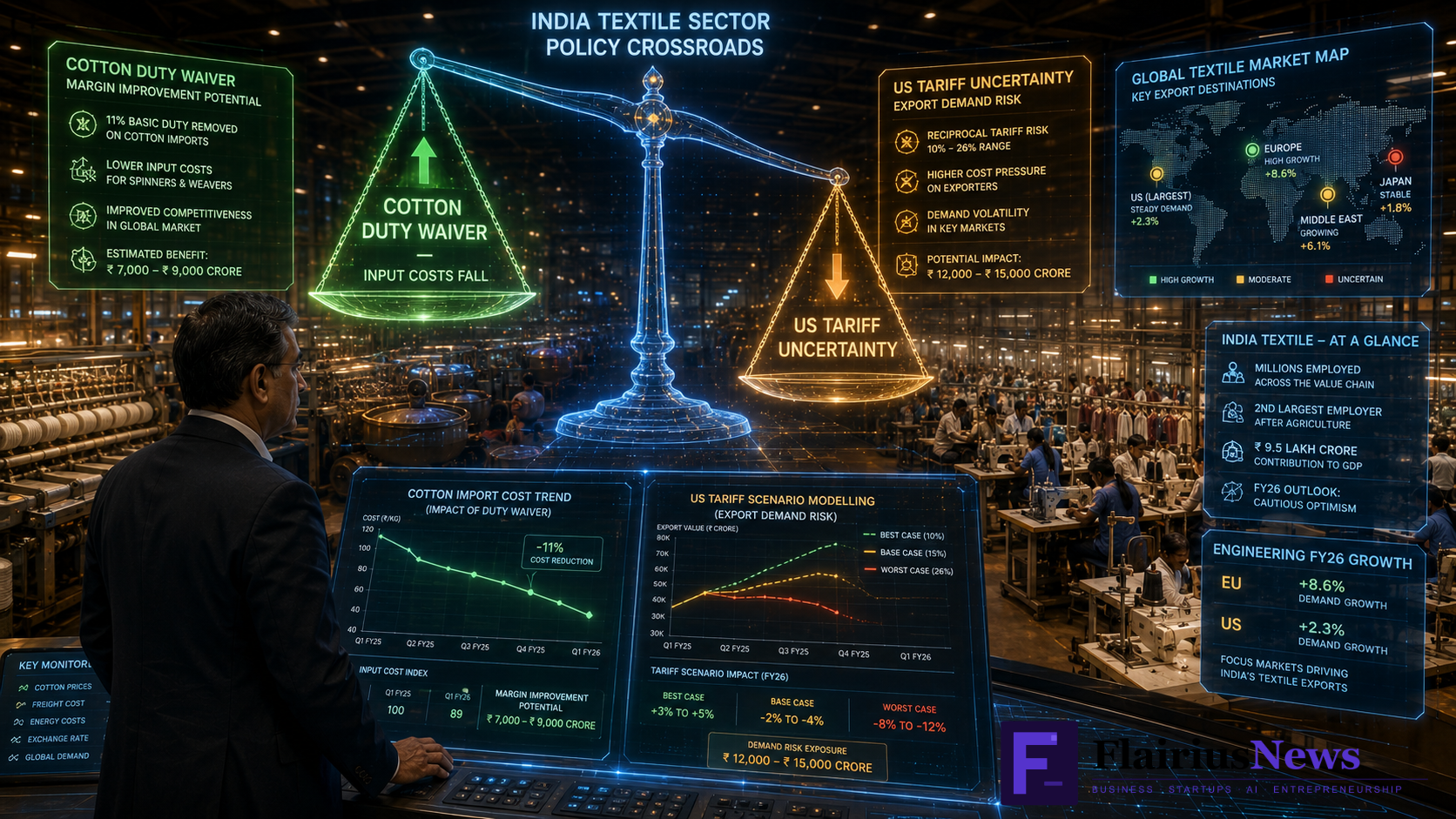
India’s textile sector received a meaningful policy concession recently. However, the benefit it can capture depends on a variable India does not fully control.
India’s cotton import-duty waiver may lower raw material costs for textile exporters. Furthermore, for a sector where cotton is the primary input cost, lower import duties directly improve margins. Consequently, domestic manufacturers and exporters can potentially reduce their finished goods pricing improving competitiveness in international markets.
However, uncertainty over proposed US tariffs could limit gains and weigh on competitiveness in that key export market. Therefore, the textile sector faces a classic mixed policy picture domestic tailwind, external headwind. Understanding both sides clearly matters for any business operating in or supplying the sector.
The Import Duty Waiver What It Does and Who Benefits
India imports cotton when domestic supply falls short or when imported varieties are needed for specific product quality requirements. Previously, import duties added meaningfully to the cost of that cotton. Furthermore, those added costs were either absorbed by manufacturers (reducing margins) or passed through to buyers (reducing competitiveness against competitors in Bangladesh, Vietnam, and Cambodia who face different cost structures).
The duty waiver addresses this directly. Specifically, it reduces the input cost for manufacturers using imported cotton. Moreover, it provides more pricing flexibility for exporters competing in global markets where buyers compare prices across multiple sourcing countries.
Additionally, India’s garment and textile sector employs tens of millions of workers. Therefore, policies that improve the sector’s competitive position have large employment implications. Consequently, the duty waiver is not just a trade technicality it has material social and economic consequences.
The US Tariff Uncertainty Why It Limits the Upside
However, the US remains India’s largest or second-largest export destination for textiles and garments. Therefore, anything that affects India’s access to the US market matters significantly.
Proposed US tariff changes under the current administration have created uncertainty specifically for Indian apparel exporters. Furthermore, higher US tariffs on Indian goods would reduce the price advantage that Indian exporters enjoy potentially offsetting the input cost savings from the cotton duty waiver entirely.
Moreover, this uncertainty affects business planning beyond just pricing. Specifically, export-focused textile companies need to make capacity investment decisions, fabric procurement decisions, and production scheduling decisions months in advance. Consequently, tariff uncertainty makes those decisions harder which in turn slows capital deployment and hiring.
What Business Owners Should Do With This
The practical response to a mixed policy environment requires clarity about which risks are controllable and which are not.
First, the duty waiver benefit is immediate and controllable. Specifically, manufacturers using imported cotton should review their procurement strategy and model the margin improvement from the waiver. Furthermore, they should assess whether the input cost reduction enables competitive price adjustments in key export markets.
Second, US tariff risk requires scenario planning rather than paralysis. Specifically, exporters should model two scenarios: one where proposed tariffs take effect at maximum levels, one where negotiations result in lower or zero tariffs. Moreover, they should identify which markets EU, Middle East, Japan, Southeast Asia can partially substitute for US export revenue if needed.
Third, the rupee’s recent strengthening adds another variable. A stronger rupee reduces the rupee value of dollar-denominated export revenue. Therefore, textile exporters should review their hedging positions alongside their tariff exposure analysis.
The textile sector has navigated complex policy environments before. Furthermore, it has built significant scale and competitiveness over decades. Consequently, the mixed 2026 environment is not an existential threat. It is a planning challenge and the businesses that plan carefully will emerge with stronger competitive positions than those that wait for clarity.
Tags: India Textile 2026, Cotton Import Duty Waiver, US Tariff India, India Garment Export, India Trade Policy, Textile Business India, India Apparel Export, India Cotton Policy 2026 Author CTA: Follow Flairius News — sharp takes on AI, business, and India’s startup economy — flairiusnews.com
 Aditya Agarwal