
 By Nayra Roy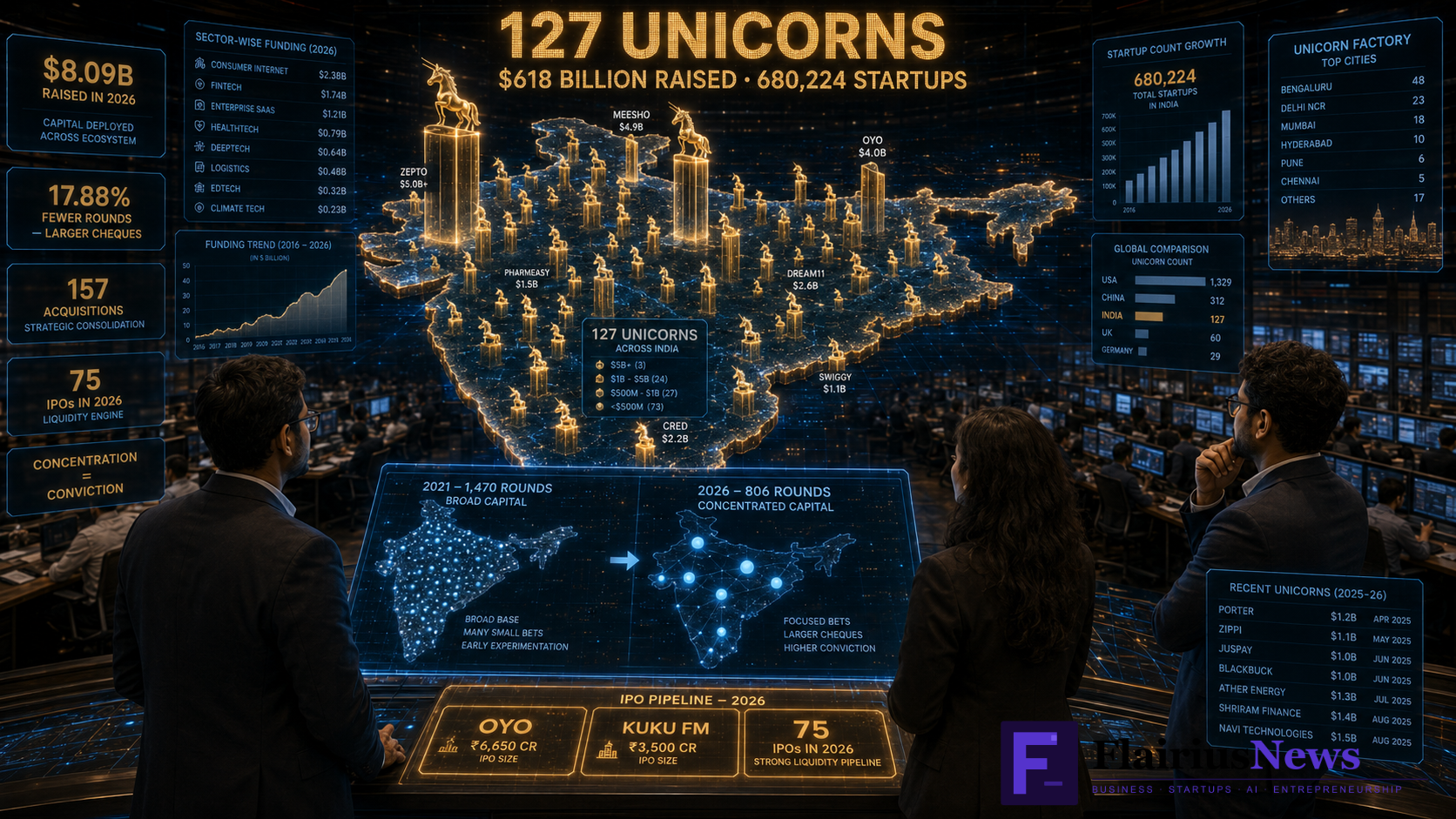
The headline numbers for India’s startup ecosystem in June 2026 are impressive. Furthermore, they are worth reading carefully — because the story beneath the headline is more nuanced and more interesting than the totals suggest.
India now has 680,224 startups. Moreover, 127 of them have crossed the unicorn threshold. Additionally, Indian startups have collectively raised $618 billion across all funding rounds since the ecosystem began. Furthermore, in 2026 alone, $8.09 billion has been raised in 806 equity funding rounds through June.
These are large numbers. However, the context matters just as much as the totals.
The Selective Funding Environment and Why It Is Actually Healthy
In the same period last year, Indian startups raised $9.85 billion across 1,470 rounds. Consequently, 2026 has seen a 17.88% drop in total funding year-on-year. Moreover, the number of rounds has dropped sharply from over 1,470 to 806. Therefore, far fewer deals are happening.
However, the average deal size has grown meaningfully. Fewer rounds at larger cheque sizes means investors are concentrating capital on higher-conviction opportunities. Furthermore, this reflects a more disciplined capital allocation environment not a funding crisis.
This distinction matters enormously. Specifically, in the 2021 boom, nearly every startup with a coherent pitch raised money. Consequently, many companies that should not have raised institutional capital did and subsequently failed or stagnated. Today’s environment is harder for the median startup. However, it is actually better for the best ones.
The IPO Pipeline Is the Real Signal
Equally important is the IPO data. In 2026 through June, 75 IPOs have happened in India against 324 for the full year of 2025. Moreover, the pipeline is building rapidly. OYO’s parent PRISM has received SEBI approval for a ₹6,650 crore offering. Kuku FM has filed confidential DRHP papers for a ₹2,500–3,500 crore raise at a ₹15,000 crore valuation.
Furthermore, these are not just financial events. They are ecosystem signals. Specifically, every successful startup IPO creates multiple downstream effects it generates liquidity for early investors, which enables reinvestment into new startups. Additionally, it creates a new class of angel investors among successful employees. Moreover, it validates the long-term returns available from Indian startup investing, attracting more institutional capital.
Consequently, the 2026 IPO pipeline is arguably the most important development in the Indian startup ecosystem this year more important than any single funding round.
The 157 Acquisitions Tell Another Story
In 2026 through June, 157 acquisitions have happened in India. Last year, 412 happened in total. Therefore, acquisition activity is tracking lower. However, acquisitions are also a signal of maturation larger companies buying smaller ones to acquire technology, talent, or market position.
Furthermore, the nature of acquisitions has shifted. Several recent deals including Ixigo’s purchase of Brevistay and its investments in Proactai and Vestra.AI reflect strategic capability acquisition rather than pure consolidation. Consequently, the startup exit landscape is increasingly diverse, with IPOs, strategic acquisitions, and secondary transactions all providing paths to liquidity.

What the 127 Unicorns Actually Represent
India’s 127 unicorns represent companies across an enormous range of sectors, geographies, and business models. However, a more useful question than “how many unicorns?” is “how are they performing post-valuation?”
The honest answer is mixed. Some like Zepto and Meesho have built genuine revenue scale and operational moats. Others earned their valuations during the 2021 peak and have struggled to grow into them since. Consequently, the IPO window is testing which unicorns were built on real foundations.
For founders building today, the lesson is clear. First, build for profitability or a clear path to it not for valuation milestones. Second, the IPO is the real test of an Indian startup in 2026. Third, the ecosystem infrastructure compliance, legal, talent, capital has never been deeper. Therefore, the failure points are increasingly about execution, not access.
Tags: India Unicorns 2026, India Startup Ecosystem, $618 Billion India Startups, India 127 Unicorns, IPO Pipeline India, India VC Trends, Indian Startup Funding Analysis June 2026 Author CTA: Follow Flairius News — sharp takes on AI, business, and India’s startup economy — flairiusnews.com
 Aditya Agarwal