
 By Ahana Verma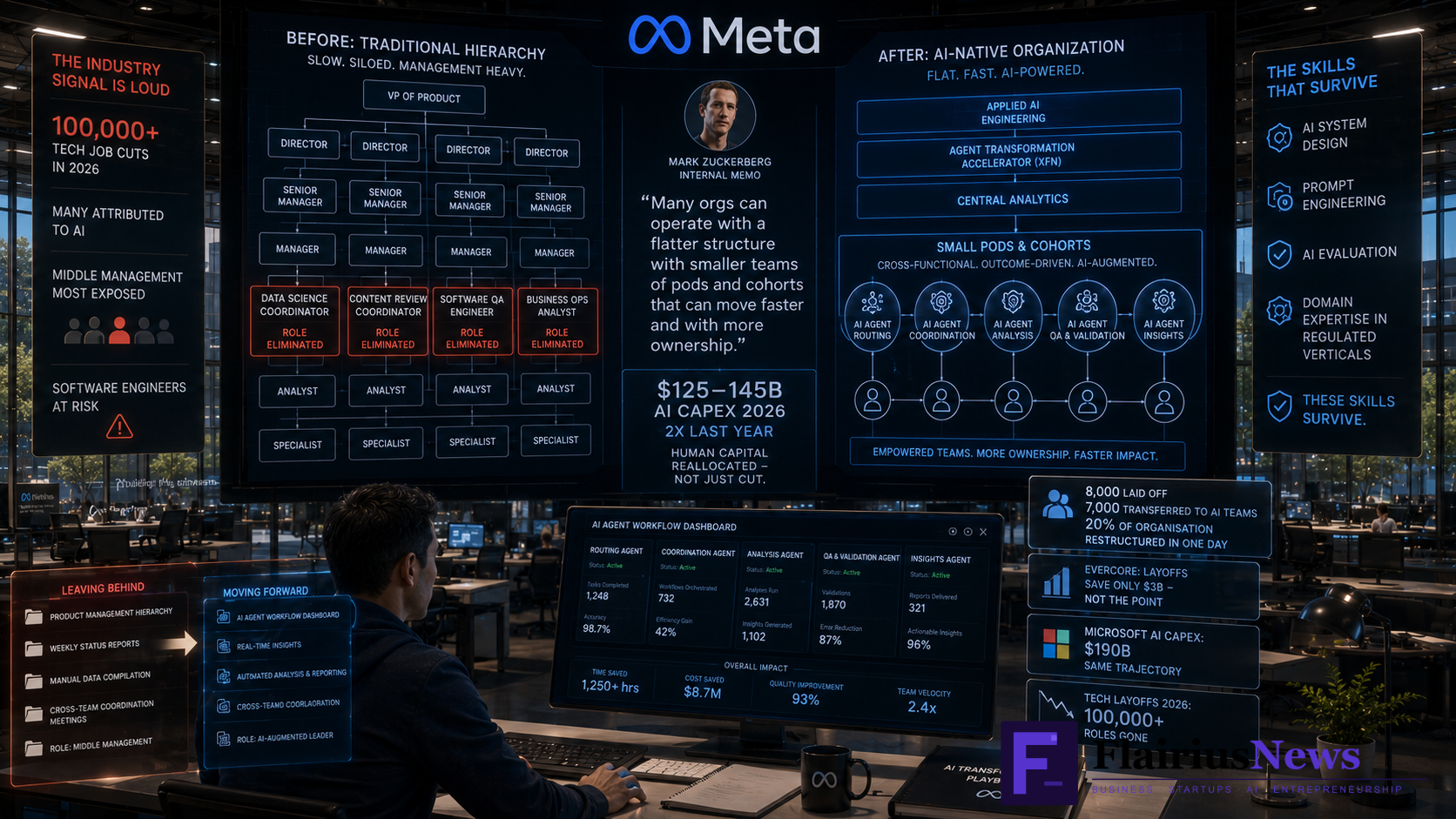
When a company cuts 10% of its workforce and simultaneously redirects 7,000 more employees to AI teams, it is not executing a cost-cutting exercise. Furthermore, it is making a statement about what the company believes the future of work looks like and who will be employable in it.
Meta made exactly that statement in May 2026. Specifically, the company notified approximately 8,000 employees globally that their roles were eliminated the largest companywide round of cuts since Mark Zuckerberg’s 2022 to 2023 “Year of Efficiency” campaign, which had removed 21,000 positions. Moreover, on the same day as the layoffs, Meta’s Chief People Officer Janelle Gale announced that 7,000 workers would be transferred to newly created AI-focused teams including Applied AI Engineering, Agent Transformation Accelerator XFN, and Central Analytics. Consequently, roughly 20% of Meta’s total organisation was reorganised in a single move.
The message was unmistakable. Specifically, Zuckerberg wrote in an internal memo that “many orgs can operate with a flatter structure with smaller teams of pods and cohorts that can move faster and with more ownership.” Furthermore, he framed the restructuring explicitly around AI’s ability to reduce the headcount required to achieve the same output. Therefore, this was not a response to declining revenue. It was a response to advancing capability.
Who Lost Their Jobs and What That Signals
The restructuring disproportionately hit two categories of employee. First, middle management specifically, more than 1,400 management positions were eliminated, accounting for nearly one-third of managerial roles cut. Second, software engineering a segment that has historically been one of the most protected in the technology industry. Moreover, data science and product management also faced significant reductions, losing 419 and 301 positions respectively.
Additionally, this pattern is not unique to Meta. Specifically, tech industry layoffs in 2026 have already exceeded 100,000 positions with many directly attributed to AI automation enabling smaller teams to match the output of larger ones. Furthermore, companies across the sector are making similar calculations: if an AI agent can handle the task that a junior employee or a middle manager previously coordinated, then that role’s budget is better spent on compute or on engineers who can build and deploy the AI agent.
Consequently, the type of role most vulnerable is now clearly identifiable. Specifically, roles that primarily coordinate, translate, or route information between other roles face the most direct exposure. Moreover, roles that primarily produce code, content, or analysis without a distinctive creative or strategic judgment component are seeing AI tools accelerate into their core function.
Why $125 to $145 Billion in AI CapEx Requires Human Capital Reallocation
Meta’s projected capital expenditures for 2026 run from $125 billion to $145 billion more than twice its 2025 outlay. Furthermore, this number represents one of the largest single-year technology infrastructure investments in history. Specifically, that capital funds GPU clusters, data centres, model training runs, and the human engineering talent required to build and deploy Meta’s AI products.
Moreover, the financial arithmetic is stark. Specifically, analysts at Evercore estimated that the 8,000 layoffs would generate only approximately $3 billion in savings a small fraction of the company’s AI infrastructure spend. Therefore, the layoffs are not primarily a cost-cutting measure. They are a reallocation moving human capital costs from roles that AI can now perform toward roles that support AI’s continued advancement.
Additionally, Meta is not alone in this calculation. Specifically, Microsoft raised its 2026 AI capital expenditure to $190 billion, citing surging memory and storage component costs. Furthermore, Google’s AI infrastructure spending is on a comparable trajectory. Consequently, the entire frontier AI layer is simultaneously expanding its compute budget and contracting its human headcount in overlapping roles creating the most significant reshaping of the technology workforce since the mobile transition of 2010 to 2015.
What This Means for AI-First Careers in 2026
The restructuring sends a clear signal to every technology professional. Specifically, the premium is shifting away from execution roles that produce standard outputs code reviews, content moderation, data annotation and toward roles that design, train, evaluate, and improve AI systems. Furthermore, roles that require judgment, creativity, ethical reasoning, and strategic synthesis qualities that AI currently struggles to replicate reliably retain their premium.
Therefore, the career advice that emerges from Meta’s restructuring is straightforward. Specifically, build skills in AI system design, prompt engineering, AI evaluation, and human-AI workflow architecture. Moreover, develop deep domain expertise in regulated verticals where AI augments rather than replaces professional judgment. Consequently, the professionals who thrive in the next decade will not be those who compete with AI tools they will be those who direct, evaluate, and improve them.
Tags: Meta Layoffs 2026, 8000 Job Cuts Meta, Zuckerberg AI Restructuring, Meta AI Teams 2026, Tech Layoffs AI Automation, Meta CapEx AI 2026, Applied AI Engineering Meta, AI Workforce Reshaping 2026, Middle Management AI Risk, AI Career Skills 2026 Author CTA: Follow Flairius News — sharp takes on AI, business, and India’s startup economy — flairiusnews.com
 Aditya Agarwal