
 By Nayra Roy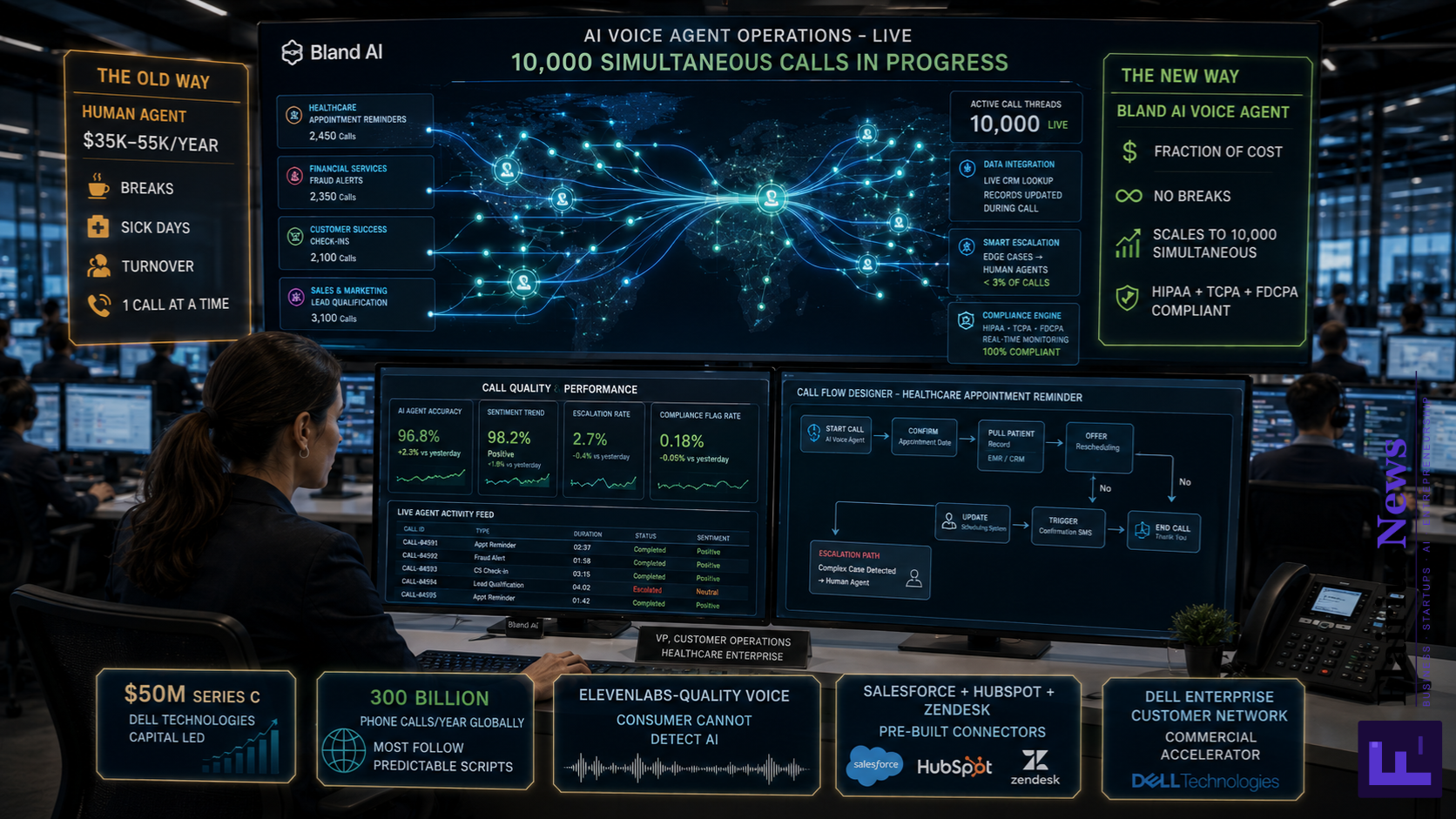
There are approximately 300 billion phone calls made globally every year. Furthermore, the vast majority of business calls customer support, appointment scheduling, lead qualification, collections, and reminders follow predictable scripts, require reliable information retrieval, and do not inherently need a human being to complete them.
Bland AI was built on exactly that insight. Moreover, it just raised $50 million to prove that AI voice agents can handle production-grade enterprise calling at scale.
The San Francisco-based startup closed a Series C round led by Dell Technologies Capital on June 16, 2026. Specifically, Bland AI builds production-grade AI voice agents not demos or experimental tools, but systems capable of handling real enterprise call volumes with the reliability, compliance, and integration depth that enterprise buyers require. Furthermore, the Dell Technologies Capital lead signals enterprise hardware and infrastructure validation a meaningful endorsement for a company selling into enterprise IT stacks.
What Bland AI Builds That Consumer Voice AI Cannot Match
The distinction between a consumer voice AI experience and an enterprise voice agent is significant. Specifically, a consumer voice AI like a smart speaker assistant handles informal, low-stakes queries with generous failure tolerance. However, an enterprise voice agent handling a hospital appointment reminder, a debt collection call, a bank fraud alert, or a SaaS customer success touchpoint must be accurate, compliant, integrated with backend systems, and capable of graceful escalation when the conversation exceeds its defined scope.
Moreover, Bland AI’s platform is specifically engineered for this production enterprise requirement. Specifically, it integrates with CRMs, scheduling systems, payment processors, and customer databases to give AI agents real-time access to the information they need during each call. Furthermore, it supports complex call flows where the conversation can branch based on customer responses, pull live data, update records mid-call, and trigger downstream actions in business systems. Consequently, Bland AI’s agents do not simply talk. They work.
Additionally, the compliance layer is critical for enterprise adoption. Specifically, regulated industries healthcare, financial services, debt collection, and insurance require AI calling systems to operate within strict legal frameworks including HIPAA, TCPA, and FDCPA. Moreover, Bland AI has built compliance controls into the platform architecture, not as an afterthought enabling enterprise customers in regulated sectors to deploy AI calling agents without creating legal exposure.
The Enterprise Voice Agent Market Why Now
Three structural shifts have made 2026 the inflection year for enterprise voice agents. First, voice synthesis quality has crossed the threshold of consumer acceptance. Specifically, modern AI voices particularly those using models from ElevenLabs and comparable providers are sufficiently natural that the vast majority of call recipients cannot immediately identify them as AI. Moreover, the quality gap between AI and human voices continues to close with every model iteration. Therefore, the “uncanny valley” that previously made AI phone calls feel uncomfortable has largely been resolved.
Second, the enterprise ROI is immediate and quantifiable. Specifically, a single human customer service agent in the US costs approximately $35,000 to $55,000 annually in salary plus benefits not including management, training, and turnover costs. Moreover, an AI voice agent handling comparable call volume costs a fraction of that per interaction. Furthermore, AI agents do not take breaks, do not get sick, and can scale from 100 to 10,000 simultaneous calls without hiring. Consequently, the cost reduction case for enterprise voice agents is one of the clearest AI ROI stories in the market.
Third, the integration infrastructure has matured. Specifically, the API ecosystem connecting AI voice agents to enterprise CRM, ERP, and customer data platforms has improved dramatically since 2024. Furthermore, companies like Bland AI have built pre-built connectors for Salesforce, HubSpot, Zendesk, and major healthcare scheduling systems. Therefore, the deployment complexity that previously made enterprise voice agents impractical has been substantially reduced.
What $50 Million Builds at This Stage
The Series C capital will fund product development across three dimensions. First, expanding the language and accent library enabling enterprise customers to deploy AI calling agents in local languages and regional accents that match their customer demographics. Second, deepening the compliance and governance layer for regulated industry deployments. Third, scaling the enterprise sales team to convert the substantial inbound demand that Bland AI’s existing product reputation has generated.
Furthermore, the Dell Technologies Capital lead creates a specific strategic advantage. Specifically, Dell’s enterprise customer relationships span healthcare systems, financial institutions, government agencies, and large corporates all of whom are actively evaluating AI voice agent deployments. Moreover, Dell’s involvement gives Bland AI warm introductions to enterprise buyers who already trust the Dell technology stack. Consequently, the $50 million is not just capital it is a commercial distribution accelerator.
Voice AI is no longer a future technology. For enterprises willing to deploy it today, it is a present cost advantage that compounds with every quarter of deployment.
Tags: Bland AI, $50M Series C, Dell Technologies Capital, AI Voice Agents, Enterprise Voice AI, Production AI Phone Calls, AI Call Centre 2026, Bland AI Platform, Voice Agent Enterprise Compliance, AI Customer Support 2026 Author CTA: Follow Flairius News — sharp takes on AI, business, and India’s startup economy — flairiusnews.com
 Aditya Agarwal