
 By Ahana Verma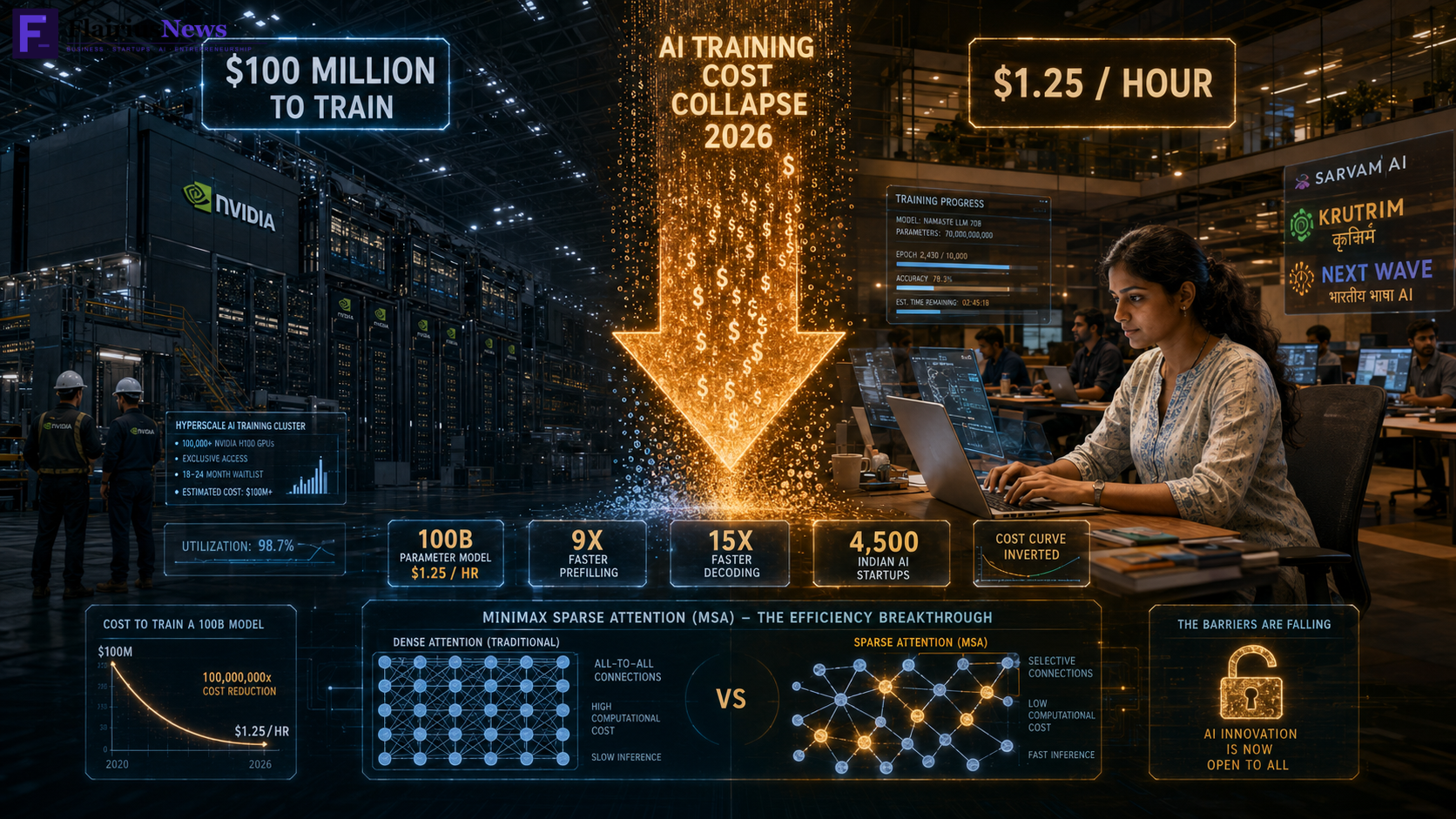
For most of the past five years, the dominant story in AI has been one of escalating costs. Training frontier AI models required hundreds of millions of dollars, access to thousands of the most powerful chips on the planet, and the kind of compute infrastructure only the largest technology companies in the world could afford. That exclusivity shaped everything which companies could build AI, which ideas could be tested, and who held power in the industry.
That story is beginning to change. And the implications for startups, for India’s AI ecosystem, and for the global distribution of AI power are profound.
The Cost Collapse Is Real — And It’s Structural
In June 2026, a company called Orion trained a 100-billion-parameter AI model comparable in scale to models that cost tens of millions of dollars just two years ago for $1.25 per hour. That is not a rounding error. That is a structural shift in the economics of AI development.
It is not an isolated data point. The Stanford HAI 2026 AI Index documents three simultaneous trends defining the current AI moment:
- AI progress is accelerating faster than any prior measurement period
- The cost of training and deploying frontier models is growing exponentially at the very top end
- The cost of training mid-tier and specialised models is collapsing for everyone else
The two trends coexist but point in different directions. At the absolute frontier GPT-5.5, Gemini 3.5, Claude Opus costs continue to rise as companies race for marginal performance improvements. But for the vast majority of AI use cases, including almost everything startups actually need to build useful products, the cost curve has inverted.
Architecture, Not Just Chips, Is Driving the Change
The cost reduction is not simply a function of cheaper chips or better infrastructure, though both have helped. The bigger driver is architectural innovation in the models themselves.
MiniMax’s M3 model, released in June 2026, illustrates the point sharply. Built on a new architecture called MiniMax Sparse Attention (MSA), it reduces per-token compute requirements to just one-twentieth of previous models while supporting context windows of up to one million tokens. The result: processing speeds 9x faster for prefilling and 15x faster for decoding at the million-token context length.
This is not a toy model. It represents a genuine performance-efficiency frontier that makes previously prohibitive applications economically viable for the first time.
Sparse attention, mixture-of-experts architectures, quantization techniques, and improved training data curation are all contributing to a world where smaller, more efficient models can achieve results that previously required much larger ones. For startups building specialized AI applications in legal, healthcare, finance, or any domain with specific language patterns this opens possibilities that simply did not exist two years ago.
What This Means Specifically for Indian AI Startups
India’s AI ecosystem is particularly well-positioned to benefit from the democratization of AI training costs. Indian AI startups have historically been constrained by the prohibitive cost of developing proprietary models, instead building primarily on top of OpenAI’s API or open-source models like Meta’s LLaMA.
As training costs fall, the calculus changes. Building a custom model trained on Indian languages, Indian legal documents, Indian financial data, or Indian healthcare records previously the exclusive domain of well-funded ventures like Sarvam AI and Krutrim becomes increasingly accessible to a broader set of founders.
This is not a hypothetical future. India already has over 4,500 active AI startups, ranking third globally. The next wave of Indian AI companies will increasingly be model developers, not just application builders and declining training costs are the single biggest enabler of that shift.
The Counterforces Worth Watching
It would be naive to ignore the other side of the coin.
While mid-tier model training is getting cheaper, the compute infrastructure required for inference at scale actually running AI applications for millions of users remains expensive. The chip shortage has eased but not disappeared. NVIDIA’s position in the AI hardware market remains dominant, and the geopolitical dimensions of chip access particularly for countries outside the US and China remain a real constraint.
There is also the question of data. Cheaper compute does not solve the problem of training data. High-quality, domain-specific, legally clear training data remains scarce and expensive to acquire or create. For Indian language models, the data challenge is arguably more significant than the compute challenge.
And at the very frontier, costs are still rising. The race between OpenAI, Google DeepMind, Anthropic, and a handful of others is an expensive one, and the gap between what these companies can build and what a well-funded startup can build may actually be widening even as mid-tier costs fall.
The Takeaway for Founders: Specialise, Don’t Compete
For founders thinking about where AI is heading, the cost trend points in one direction: specialisation.
The era of one general-purpose AI model for everything is not ending, but it is being complemented by a new era of highly efficient, domain-specific models that can be trained and deployed at a fraction of the historical cost.
The opportunity for Indian startups is not to out-spend OpenAI. It is to out-specialize them to build models that understand Indian contexts, Indian languages, and Indian problems better than any global model ever will. The cost barriers to doing that are falling. The window to act on that opportunity is open.
The question is which Indian founders will move through it.
Tags: AI Training Costs, AI Democratisation, MiniMax M3, Indian AI Startups, Affordable AI, Sparse Attention, AI Architecture 2026, Startup AI, Sarvam AI, Krutrim Author CTA: Follow Flairius News for sharp takes on AI, startups, and the future of business in India and beyond — flairiusnews.com
 Aditya Agarwal
  Raghav Sharma