
 By Raghav Sharma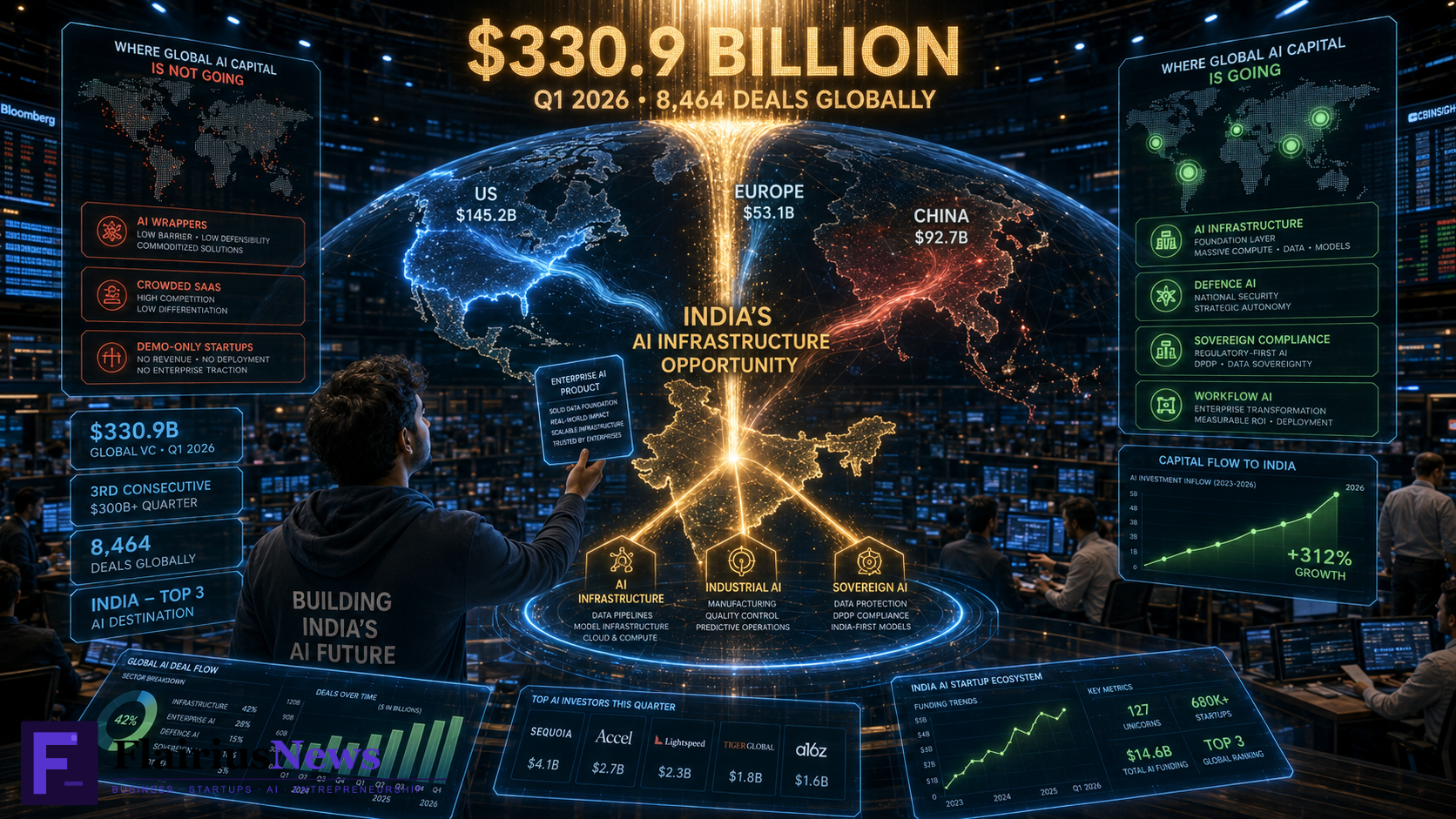
The global AI funding machine is not slowing down. In fact, it is accelerating.
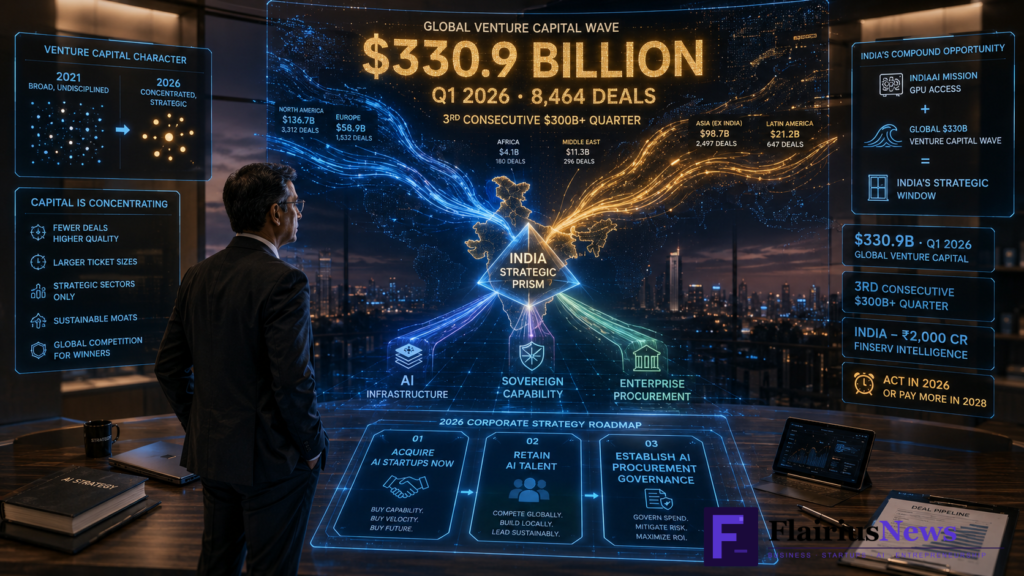
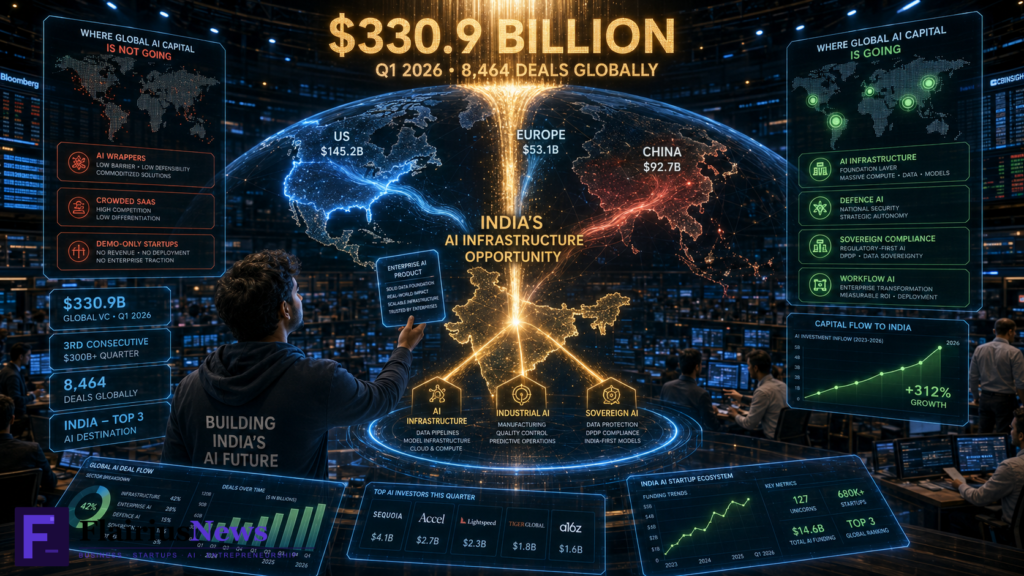
Global venture investment reached $330.9 billion in Q1 2026 the third consecutive quarter with over $300 billion in deals globally, spanning 8,464 deals. Furthermore, capital is not spreading evenly. Instead, it is concentrating deliberately. Consequently, understanding where it is going and why is one of the most important strategic exercises an Indian AI founder can do right now.
Where Global AI Capital Is Concentrating
Venture investment in June 2026 is crowding into companies that appear capable of owning strategic infrastructure. Specifically, foundational AI platforms, compute-heavy businesses, semiconductor-adjacent ventures, data systems, cybersecurity layers, and automation tools with immediate enterprise demand are capturing disproportionate share.
Moreover, the market is no longer rewarding the average software company simply for being modern. Instead, it rewards companies that sit close to budget lines that boards already understand. In a year still shaped by rate uncertainty and geopolitical friction, discretionary optimism has become expensive. Therefore, investors have become more suspicious of demos and more respectful of procurement contracts.
This shift has a direct implication for Indian founders. Specifically, building AI that enterprise procurement teams can justify to a CFO is more valuable than building AI that product teams get excited about but struggle to budget.
The Concentration Dynamic and What It Means
The most interesting opportunities in June 2026 are emerging where technology meets necessity. AI infrastructure remains the obvious centre of gravity. However, the better opportunities may not belong only to the largest model companies.
Furthermore, enterprise software is regaining stature but not in the loose SaaS sense that defined the previous decade. Instead, winners are companies that understand workflow depth rather than interface design. Consequently, the question is not what industry a startup is in. The question is how deeply it understands the specific workflow it is replacing or augmenting.
Additionally, defence tech and spacetech have moved closer to mainstream venture discussion. Persistent geopolitical tensions have changed the investor view of sovereign capability and autonomous systems. Therefore, Indian founders building in national security AI, drone technology, and space infrastructure are operating in a tailwind that did not exist three years ago.
The Specific Opportunity for Indian Founders
India captures this global shift with unusual clarity. The country is not in a funding winter in the old sense. However, nor is it enjoying a broad revival. Instead, investors have changed their method concentrating capital on fewer companies with higher conviction.
For Indian AI founders, this environment creates three specific opportunities. First, infrastructure-layer AI. Companies that build the data pipelines, model evaluation tools, and deployment infrastructure that larger AI systems depend on sit close to the budget lines that matter. Furthermore, these products sell to engineering and operations teams the same teams currently spending on cloud infrastructure.
Second, AI for India’s industrial economy. India’s engineering exports hit $122 billion in FY26. Moreover, India’s manufacturing base is actively expanding. Consequently, AI for quality control, supply chain optimisation, and predictive maintenance has a large, growing, export-generating customer base. LevelPlane selected for the Google-Accel Atoms cohort specifically for industrial automation is one example.
Third, sovereign and compliance AI. Geopolitical tensions have made data sovereignty a board-level conversation in India. Therefore, AI products that keep data within Indian borders, comply with India’s Digital Personal Data Protection Act, and integrate with India’s digital public infrastructure have a structural advantage over foreign alternatives.
The Action Step
Global AI capital is available in 2026 at a scale that has no historical precedent. However, it requires a specific kind of company to access it one building genuine infrastructure, solving structural problems, and capable of demonstrating procurement-ready enterprise traction.
Therefore, Indian founders who can answer “which budget line does this come from?” before answering “which problem does this solve?” are building the kind of companies that global capital is currently hunting for.
The $330 billion wave is real. Moreover, it is looking for Indian companies to invest in. Build the right thing.
Tags: Global AI Venture 2026, AI Funding Wave, Indian AI Opportunity, Enterprise AI Infrastructure, India Defence Tech, Sovereign AI India, AI Startup Strategy 2026, Venture Capital India Author CTA: Follow Flairius News — sharp takes on AI, business, and India’s startup economy — flairiusnews.com
 Aditya Agarwal