
 By Raghav Sharma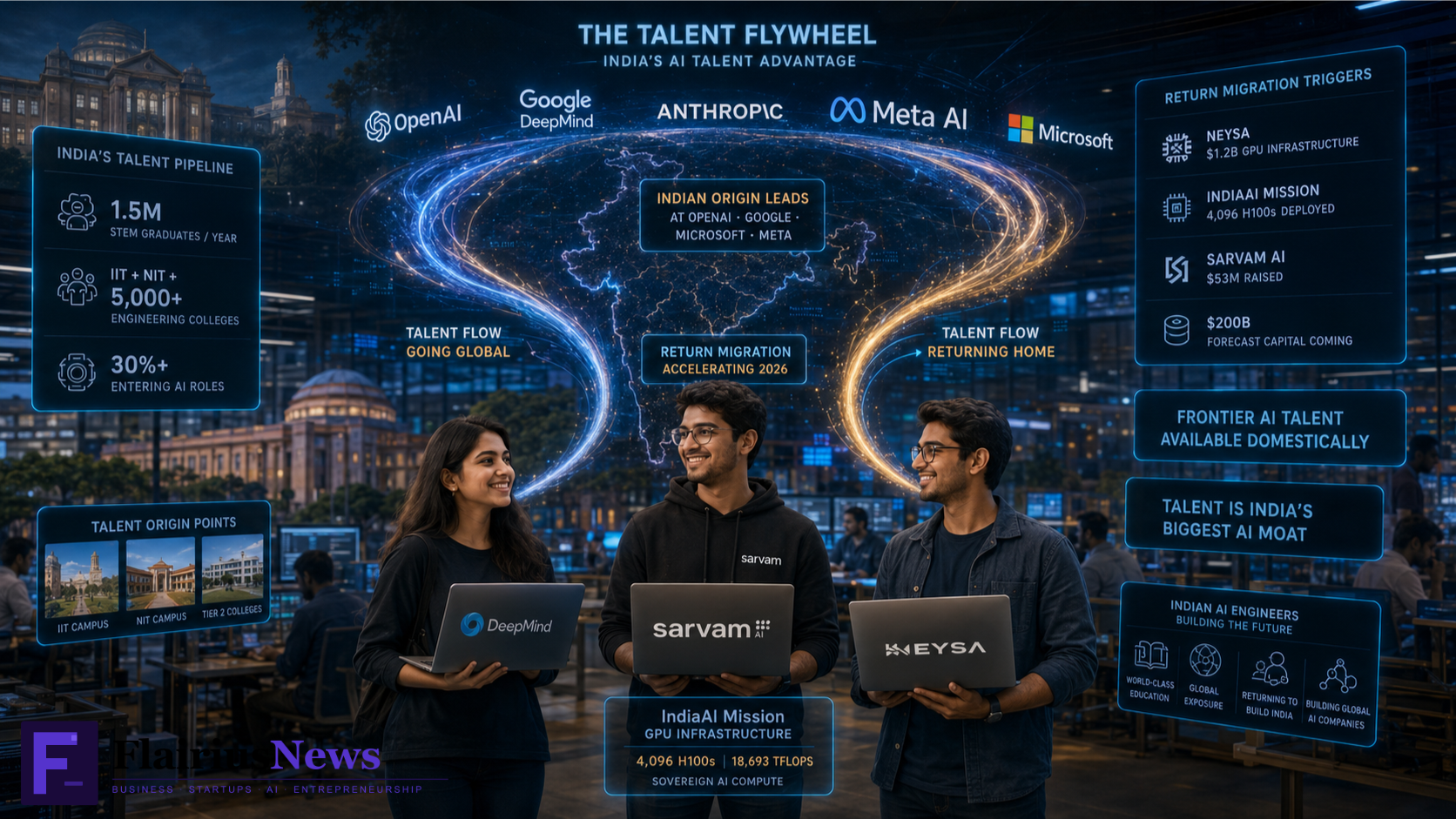
India’s most significant AI export is not a product. Furthermore, it is not a model. It is people.
India produces approximately 1.5 million STEM graduates annually. Moreover, a disproportionate share of the world’s most impactful AI researchers, engineers, and product leaders trace their origins to India from IIT campuses, from NIT corridors, from Tier 2 city engineering colleges that global university rankings have never heard of.
This talent reality is increasingly determining where AI leadership sits and consequently, why India’s own AI ecosystem is accelerating faster than any policy programme could achieve independently.
The Indian Engineering Advantage
Indian engineers dominate AI leadership at global companies. Specifically, Sundar Pichai (Google), Satya Nadella (Microsoft), Sriram Krishnan (US AI Office), Arvind Krishna (IBM), and Shantanu Narayen (Adobe) collectively lead technology companies with a combined market capitalisation exceeding $10 trillion.
Moreover, the engineering pipeline beneath these visible leaders is enormous. Specifically, product and research teams at OpenAI, Anthropic, Google DeepMind, Meta AI, and Amazon AGI all have significant concentrations of Indian-origin engineers. Furthermore, these engineers bring a specific intellectual culture mathematical rigour, problem decomposition, strong foundational CS training that maps particularly well to AI research and engineering.
Additionally, the founding teams of the most recent generation of significant US AI companies include numerous Indian-origin founders. Furthermore, the pattern is accelerating Indian engineers who have spent 5–10 years at frontier AI companies are returning to India to build, attracted by the IndiaAI Mission compute access, the venture capital availability, and the scale of India’s domestic market.
The Return Migration Trend
The talent return story is one of the most important and underreported trends in India’s AI ecosystem. Specifically, the combination of IndiaAI Mission compute subsidies, government policy support, and the global recognition of India as an AI destination has changed the calculus for Indian engineers considering returning home.
Five years ago, an Indian AI researcher who had spent a decade at Google Brain had limited options in India. Specifically, the compute infrastructure to train serious models did not exist domestically. Furthermore, the venture capital ecosystem was not calibrated to back deep research-intensive AI companies. Consequently, the rational choice was to stay in the US.
Today, both of those constraints have materially eased. Specifically, Neysa’s $1.2 billion Blackstone-backed GPU infrastructure deployment is creating compute capacity in India that approaches what was previously only available in the US. Moreover, Sarvam AI raised $53 million and received 4,096 H100 GPUs from the IndiaAI Mission enough to train frontier models in India.
Consequently, an Indian AI researcher returning from DeepMind or OpenAI can now find the compute, the capital, and the talent ecosystem to build something serious domestically.
The Corporate AI Talent Competition
However, the talent return trend also creates a competition problem. Specifically, as India’s AI ecosystem grows, demand for AI engineering talent is outpacing supply at premium levels. Moreover, global companies Microsoft, Google, Amazon are actively building India engineering operations to access the talent without the relocation friction.
Microsoft committed $17.5 billion to India specifically including workforce development. Furthermore, Google is expanding its India AI engineering presence alongside the Visakhapatnam data centre build. Consequently, Indian AI engineers who previously needed to relocate to access frontier AI roles can now access them domestically at companies like Google India or Microsoft India AI alongside Indian startups.
This dynamic creates a virtuous cycle for the ecosystem. Specifically, more high-quality AI work happening in India trains more engineers who could become future founders. Moreover, the salary benchmarks that global companies set create career incentives that attract more engineers into AI roles domestically.
What This Means for Indian AI Founders
For Indian founders, the talent pool is both an opportunity and a challenge. Specifically, the quality of Indian AI engineering talent available domestically has never been higher. Furthermore, the return migration trend is bringing back engineers with frontier AI experience who previously would only have built in the US.
However, competing for this talent requires more than salary. Specifically, the most experienced returning Indian AI engineers have typically had frontier AI access at their previous companies. Therefore, startups that can offer frontier-quality technical problems, meaningful equity, and a mission connected to India’s AI future will attract talent that cannot be bought by salary alone.
Consequently, the founders who are building the most important Indian AI companies in 2026 are not just building products. They are building the talent environments that attract the engineers who make those products possible.
Tags: India AI Talent, STEM Graduates India, Indian Engineers Global AI, AI Talent Return India, IndiaAI Mission Talent, Google India AI, Microsoft India AI, Indian AI Founders 2026 Author CTA: Follow Flairius News — sharp takes on AI, business, and India’s startup economy — flairiusnews.com
 Aditya Agarwal