
 By Nayra Roy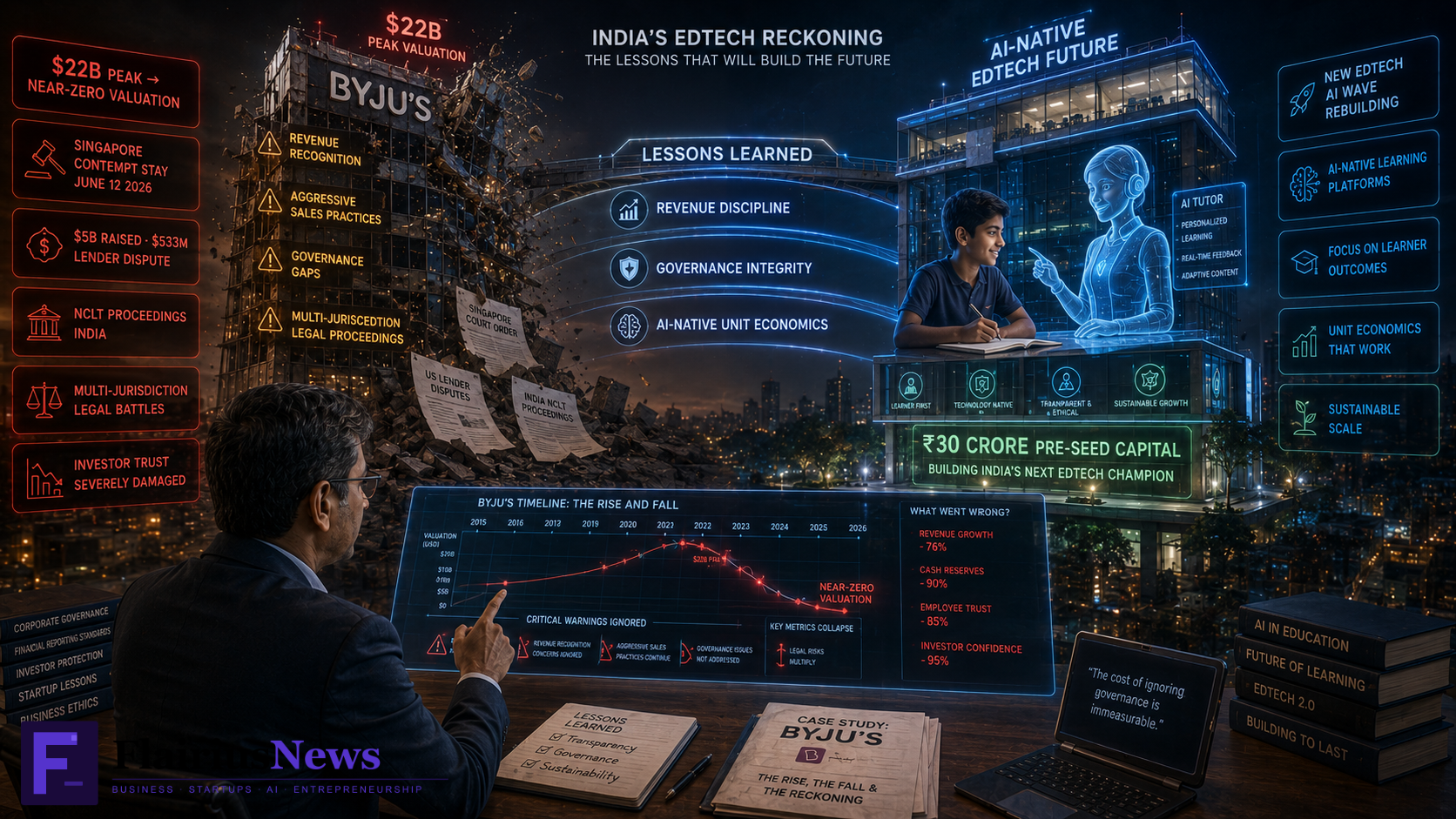
The BYJU’S story is India’s most dramatic cautionary tale. Furthermore, it is not over.
On June 12, 2026, the Singapore High Court stayed a contempt sentence against BYJU’S founder Byju Raveendran. Specifically, the stay was granted pending appeal of an earlier contempt finding related to proceedings in the US. Consequently, Raveendran avoided immediate imprisonment but the underlying legal proceedings continue across multiple jurisdictions.
The story is complicated. Moreover, it is important. Not because BYJU’S itself matters as much as it once did the company’s operating business has collapsed from a peak valuation of $22 billion to near-worthlessness but because the lessons from its rise and fall are directly relevant to every Indian founder and investor in 2026.
What Actually Happened at BYJU’S
BYJU’S peaked in 2022 at a $22 billion valuation making it India’s most valuable startup and one of the world’s most valuable EdTech companies. Specifically, it raised over $5 billion from investors including Tiger Global, Prosus, General Atlantic, and Sequoia Capital.
However, the company’s growth was built on a combination of genuinely good product, aggressive sales practices, and financial reporting that multiple investigations have since characterised as misleading. Specifically, BYJU’S recognised revenue in ways that inflated reported growth, acquired companies at valuations that required continuous growth to justify, and built a cost structure that assumed fundraising would continue indefinitely.
When the funding environment tightened in 2022, every one of these assumptions collapsed simultaneously. Furthermore, lenders to BYJU’S US entity who had extended $1.2 billion in a term loan moved to enforce their security. Moreover, US courts found that BYJU’S had transferred approximately $533 million out of the reach of these lenders leading to the contempt proceedings against Raveendran.
The Singapore Court’s Stay and What It Does Not Change
The Singapore High Court’s decision to stay the contempt sentence pending appeal is a procedural development, not a substantive exoneration. Specifically, the stay means Raveendran will not face immediate imprisonment while the appeal is heard. However, it does not resolve the underlying contempt finding or the broader multi-jurisdictional legal proceedings.
Moreover, the BYJU’S operating business Think & Learn Private Limited has been through insolvency proceedings in India. Furthermore, the National Company Law Tribunal has been involved in the company’s restructuring. Consequently, the legal complexity spans Singapore, the US, and India simultaneously.
The Singapore stay was granted because the court found the appeal raised sufficiently serious questions to merit consideration. Therefore, the legal story will continue for months if not years.
What India’s EdTech Ecosystem Learned
The BYJU’S collapse is painful. However, it has produced several clear lessons that India’s startup ecosystem has absorbed unevenly, but genuinely.
First, revenue recognition discipline matters. Specifically, BYJU’S recognised sales before cash was collected and in ways that regulators and investors later questioned. Moreover, its auditors resigned. Therefore, Indian startups in 2026 face much more rigorous financial diligence from investors who learned from the BYJU’S experience.
Second, aggressive sales practices have long-term costs. Specifically, BYJU’S sales teams were widely reported to have pressured families including lower-income families into taking EMI-based education loans for products that did not deliver the promised outcomes. Consequently, the brand damage was severe and structural. Furthermore, the National Consumer Helpline received thousands of complaints.
Third, governance structures protect founders as much as investors. Specifically, BYJU’S board composition and governance frameworks were widely criticised as inadequate for a company of its scale. Moreover, key investors resigned from the board as the crisis deepened. Therefore, founder-led governance that resists oversight creates legal and reputational risks for founders themselves not just investors.

The EdTech Market That Survived BYJU’S
Despite BYJU’S collapse, India’s EdTech market itself has not collapsed. Specifically, the category that BYJU’S damaged most was test-preparation and K-12 tutoring and even that category is recovering, now being rebuilt by AI-native companies like ProLearn with fundamentally different unit economics.
Furthermore, adjacent EdTech categories professional upskilling (upGrad), higher education (Great Learning), and vernacular skill training have grown through the BYJU’S crisis. Consequently, the market needed cleansing, not abandonment.
Moreover, the rise of AI-native EdTech represented by ProLearn’s ₹30 crore pre-seed suggests the next EdTech wave will be built on conversational AI tutoring rather than recorded lectures and aggressive EMI sales. Therefore, BYJU’S collapse may ultimately have accelerated the arrival of a better EdTech model.
Tags: BYJU’S, Byju Raveendran Singapore, EdTech India Collapse, India EdTech 2026, BYJU’S Legal Case, India Startup Governance, EdTech Lessons India, ProLearn EdTech AI, India Startup Crisis Author CTA: Follow Flairius News — sharp takes on AI, business, and India’s startup economy — flairiusnews.com
 Aditya Agarwal