
 By Nayra Roy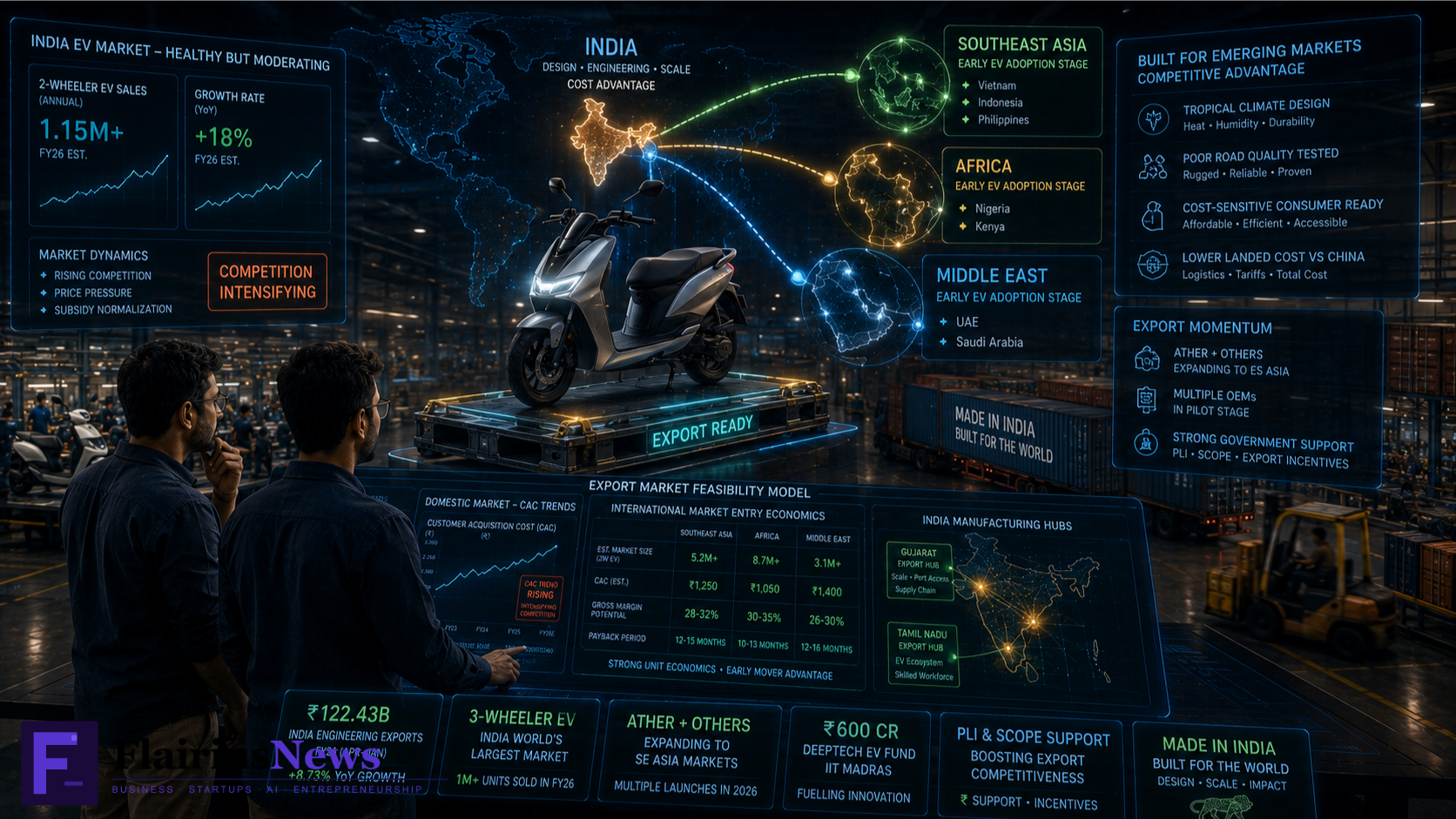
India’s EV sector had a plan. Build electric two-wheelers and three-wheelers for the domestic market. Benefit from FAME subsidies. Scale to a billion customers.
The plan is working but not fast enough for the companies that built ahead of the demand curve. Consequently, India’s EV startups are increasingly looking beyond the domestic market. Specifically, they are targeting Southeast Asia, Africa, and the Middle East geographies where EV adoption is at a similar stage to where India was three years ago.
Furthermore, this export pivot is coming at precisely the right moment. India’s engineering exports hit a record $122.43 billion in FY26. Moreover, the government is actively encouraging Indian manufacturers to build export capacity. Consequently, EV exports fit into a larger national industrial policy narrative and access government support as a result.
Why Domestic EV Demand Has Slowed Relative to Expectations
India’s EV two-wheeler market grew strongly in FY25. However, the growth rate has moderated in FY26. Specifically, the transition from FAME II to FAME III subsidies created a period of policy uncertainty that slowed fleet operator procurement. Furthermore, consumer awareness of charging infrastructure gaps particularly outside metros is tempering adoption in Tier 2 and Tier 3 cities.
Additionally, the competitive intensity in the domestic market has increased dramatically. Specifically, Ola Electric, Ather Energy, TVS iQube, Bajaj Chetak, and Hero Vida are all fighting for the same urban consumer. Moreover, the entry of Simple Energy, Okinawa, and smaller regional players has further fragmented the market. Consequently, customer acquisition costs are rising while pricing pressure is compressing margins.
Therefore, the most forward-thinking Indian EV founders are simultaneously fighting for domestic market share and opening international revenue streams to diversify their risk.
The Export Opportunity Why Now
Three factors make the export opportunity particularly attractive right now. Therefore, understanding each one matters.
First, India’s manufacturing cost structure is competitive. Specifically, Indian labour costs, component sourcing ecosystems, and manufacturing infrastructure particularly in Tamil Nadu and Gujarat give Indian EV manufacturers a landed cost advantage in export markets compared to Chinese competitors facing tariff barriers in Southeast Asia and Africa.
Second, several target export markets are at early EV adoption stages. Specifically, Vietnam, Indonesia, the Philippines, Nigeria, Kenya, and the UAE are all seeing rising fuel costs, increasing two-wheeler and three-wheeler usage, and growing consumer interest in lower total cost of ownership EVs. Moreover, Indian EV products designed for tropical climates, poor road quality, and cost-sensitive consumers are better suited to these markets than Chinese products designed for different conditions.
Third, the NHEV electric highway programme and India’s overall EV infrastructure buildout is creating reference deployments that demonstrate Indian EV technology at scale. Consequently, export sales conversations that previously required extensive proof-of-concept are becoming faster and simpler.
Which Indian EV Companies Are Moving First
Several Indian EV companies are already active in export markets. Specifically, EV two-wheeler makers with established domestic production have been the first movers Ather Energy has announced Southeast Asia expansion plans, and several three-wheeler EV companies have active export programmes to Africa and the Middle East.
Moreover, the electric three-wheeler segment is particularly compelling for export. Specifically, three-wheelers are the dominant last-mile mobility solution across much of Africa, Southeast Asia, and South Asia. India is already the world’s largest three-wheeler market. Therefore, Indian three-wheeler EV manufacturers have both production scale and product experience that export markets need.
Additionally, the IIT Madras and Unicorn India Ventures ₹600 crore deeptech fund which explicitly includes EV technology provides a capital pathway for deeptech EV companies building for global markets.
What Founders Building in EV Should Do
For Indian EV founders, the domestic-export balance is the central strategic question of 2026. Specifically, founders should model their business at two scale points: at domestic market penetration rates that are achievable in the next 18 months, and at export volumes that international market entry could unlock in the same period.
Furthermore, the product decisions for export are often different from domestic product decisions. Specifically, right-hand drive configurations, different voltage standards, and specific climate requirements in target export markets require product adaptation investment. Moreover, regulatory certification for export markets CE marking for Europe, EAC for Russia and CIS, and local standards for Southeast Asian markets requires lead time.
Therefore, founders who start the export preparation process now will be ready to scale internationally when domestic market dynamics create the motivation to do so urgently. The time to prepare is before the urgency arrives.
Tags: India EV Export 2026, Indian Electric Vehicle Startups, EV Southeast Asia, EV Africa Market, FAME III India, EV Two-Wheeler Export, Domestic EV Slowdown India, India Electric Mobility Global Author CTA: Follow Flairius News — sharp takes on AI, business, and India’s startup economy — flairiusnews.com
 Aditya Agarwal