
 By Nayra Roy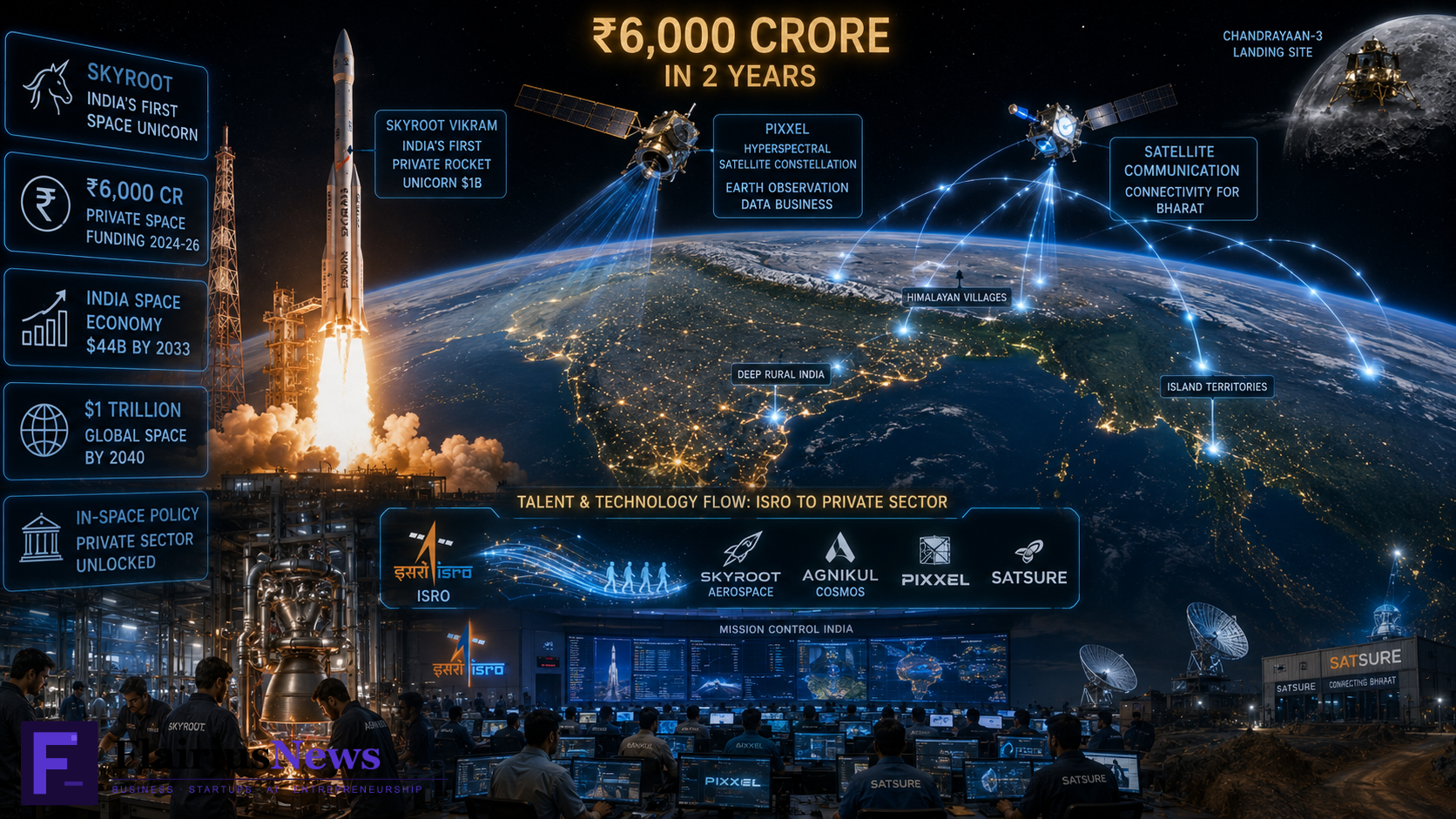
India sent a mission to the Moon in 2023. Furthermore, it successfully soft-landed on the lunar south pole. Moreover, it did it for ₹615 crore approximately $74 million a fraction of what any Western space agency would have spent on the same mission.
That cost efficiency is not just a national achievement. It is a commercial signal. And India’s private space sector has been building on that signal with growing urgency ever since.
In the two years between 2024 and 2026, India’s space technology startups raised approximately ₹6,000 crore in funding. Furthermore, Skyroot Aerospace India’s first private space company to successfully launch a rocket crossed the $1 billion valuation threshold in May 2026, becoming India’s first space unicorn. Consequently, India’s space decade has officially started.
What India’s Space Startups Are Actually Building
India’s private space sector is not building tourist rockets. Instead, it is building the commercial infrastructure that a space-dependent digital economy requires.
Specifically, the three most commercially significant categories are:
First, satellite launch services. Skyroot Aerospace and Agnikul Cosmos are building small satellite launch vehicles rockets that can place communication, observation, and research satellites into orbit on demand. Furthermore, the global small satellite launch market is growing rapidly as companies in every industry agriculture, logistics, insurance, defence deploy constellations for earth observation and connectivity. Consequently, launch services have predictable commercial demand.
Second, earth observation and data analytics. Pixxel, a Bengaluru startup, is building a constellation of hyperspectral imaging satellites that can detect crop disease, mineral deposits, pollution sources, and deforestation with a precision that existing satellite networks cannot match. Moreover, its data products are already generating commercial revenue from agriculture, mining, and government customers. Therefore, Pixxel is a data business that happens to operate satellites not a space company trying to find customers.
Third, satellite communication and connectivity. The Indian government’s approval of Starlink’s operations in India has created a reference market that Indian satellite connectivity startups are building toward. Furthermore, India’s geographic diversity remote mountains, island territories, deep rural areas creates genuine demand for satellite connectivity that terrestrial networks cannot serve. Consequently, companies building India-specific satellite communication solutions have a clear domestic market.
The Policy Environment Enabling Private Space
India’s space sector has been transformed by policy as much as technology. Specifically, the Indian Space Policy 2023 opened the sector to private companies in a way that was not previously possible. Moreover, IN-SPACe the Indian National Space Promotion and Authorisation Centre has been actively licensing private space activities and facilitating ISRO knowledge transfer to private companies.
Furthermore, the government has committed to a $8 billion investment in the space sector over the next decade. Additionally, the defence procurement environment is creating government customers for space-based intelligence, surveillance, and reconnaissance capabilities directly benefiting companies like Pixxel and SatSure.
The policy momentum has global attention. Specifically, the US, France, and Japan have all signed space cooperation agreements with India that include provisions for commercial collaboration. Therefore, Indian space startups have access to international partnership opportunities that were unavailable five years ago.
Skyroot’s Unicorn Status What It Signals
Skyroot Aerospace’s crossing of the $1 billion valuation threshold is a landmark beyond the number. Specifically, it is the first Indian private space company to reach unicorn status. Furthermore, it has successfully launched a suborbital rocket making it one of only a handful of private companies globally to demonstrate in-flight launch capability.
Moreover, Skyroot’s investors include Temasek, Kalaari Capital, Beenext, and GIC a combination of Singaporean sovereign wealth, Indian venture capital, and Japanese early-stage investors that reflects genuine global conviction in Indian private space. Consequently, the capital base for Indian space startups has diversified internationally.
Why ₹6,000 Crore in Two Years Is Just the Beginning
India’s space economy is valued at approximately $8 billion currently. Furthermore, the government projects it could reach $44 billion by 2033. Moreover, the global space economy is forecast to exceed $1 trillion by 2040 driven by satellite connectivity, earth observation data, and the broader commercialisation of low-earth orbit.
India is participating in this growth from a position of specific competitive advantage. Specifically, ISRO’s launch cost efficiency has created engineering traditions that Indian private companies inherit. Moreover, the talent pool of ISRO engineers increasingly flows into private sector companies the same talent transfer that made India’s IT sector globally competitive.
Therefore, the ₹6,000 crore raised in two years is not the peak of India’s space investment cycle. It is the base.
Tags: India Space Startups, Skyroot Aerospace Unicorn, Pixxel Satellite, India Space Funding ₹6000 Crore, IN-SPACe India, Private Space India 2026, India Space Economy, Agnikul Cosmos, India Space Policy Author CTA: Follow Flairius News — sharp takes on AI, business, and India’s startup economy — flairiusnews.com
 Ahana Verma