 By Ahana Verma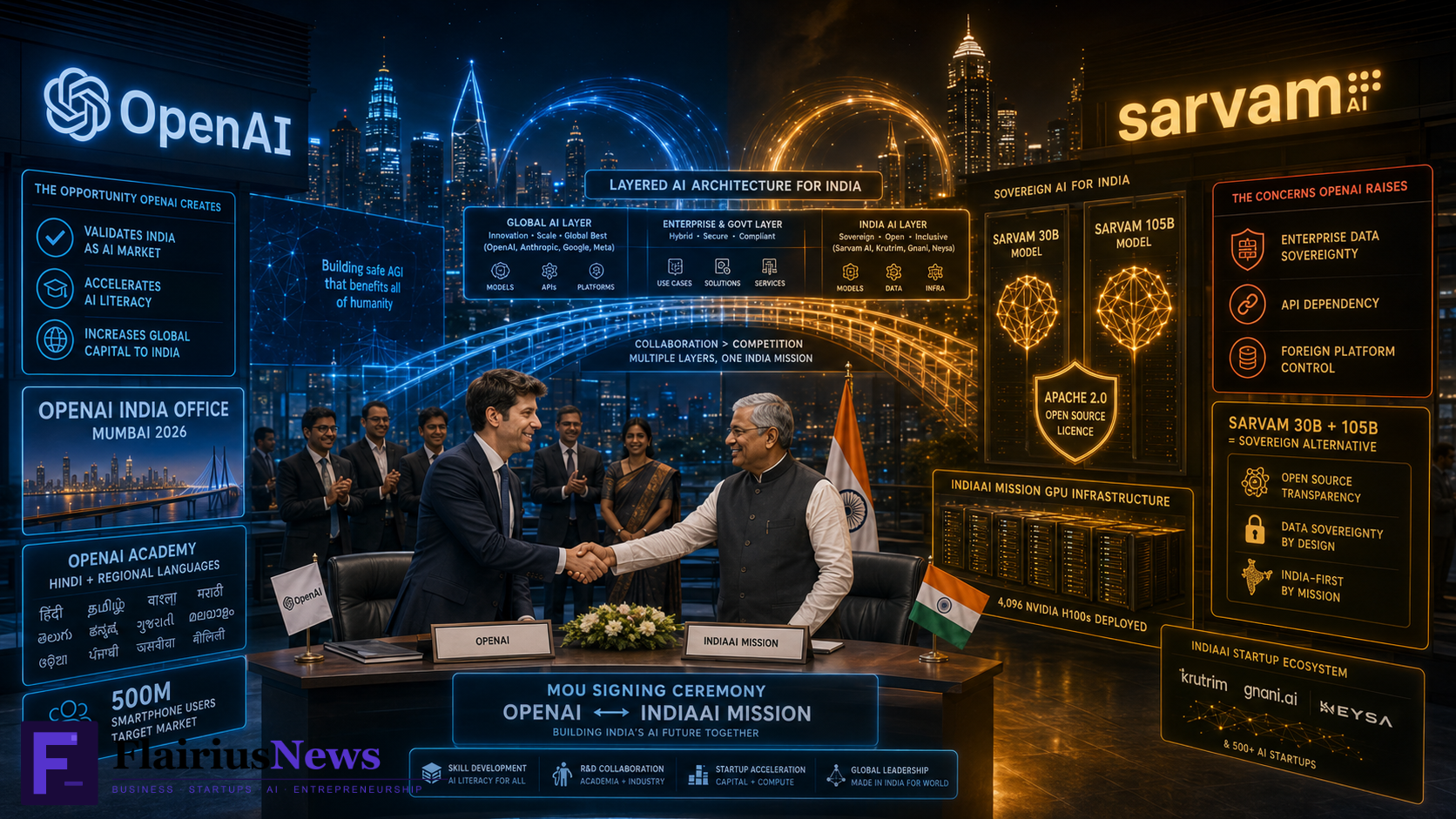
OpenAI came to India. Furthermore, it came with a government MoU, an IIT-based Academy, and the stated ambition of making India a priority market for AI deployment.
In early 2026, OpenAI opened its first office in India based in Mumbai and signed a memorandum of understanding with the IndiaAI Mission. Additionally, OpenAI committed to establishing an Academy in Hindi, English, and regional languages. Consequently, the world’s most recognised AI company has made its most significant emerging market bet and it chose India.
However, the more important question is not what OpenAI is doing in India. It is what OpenAI’s arrival means for Indian AI founders, Indian AI companies, and India’s sovereign AI ambitions.
What OpenAI Is Actually Committing To
The MoU with IndiaAI Mission covers several specific areas. Specifically, it includes collaboration on AI policy and safety standards, support for the IndiaAI Mission’s compute programme, and the establishment of an OpenAI Academy. Moreover, the Academy will provide AI education resources in Hindi, English, and regional Indian languages potentially reaching hundreds of millions of learners.
Furthermore, Sam Altman’s visit to India and meetings with Prime Minister Modi signalled that India has moved from a market OpenAI serves to a market OpenAI is actively investing in. Specifically, India’s 500 million smartphone users, its 1.5 million STEM graduates annually, and its position as the world’s third-largest AI startup ecosystem make it a priority for any global AI platform seeking long-term dominance.
Additionally, the enterprise side of OpenAI’s India strategy is significant. Specifically, Indian enterprises from Tata and Reliance to the government’s digital infrastructure programmes are potential large-scale customers for OpenAI’s enterprise API products. Moreover, the presence of a local office enables the relationship development that global enterprise sales require.
The Opportunity OpenAI’s Arrival Creates for Indian Founders
Here is the counterintuitive argument: OpenAI’s arrival in India is net positive for Indian AI startups including those that compete with OpenAI.
First, OpenAI’s presence validates India as an AI market. Specifically, when the world’s most prominent AI company opens an office in Mumbai and signs a government MoU, it signals to global investors that India’s AI ecosystem deserves serious capital allocation. Consequently, the fundraising environment for Indian AI startups improves as global investors follow OpenAI’s market signal.
Second, OpenAI’s general-purpose models create demand for Indian specialisation. Specifically, GPT-5 handles common tasks well. However, it handles Indian-specific tasks regional language customer service, Aadhaar-linked financial verification workflows, agricultural advisory in Bhojpuri poorly compared to models trained natively for these contexts. Therefore, every Indian vertical where OpenAI’s models underperform is an opportunity for Indian companies like Sarvam AI, Gnani.ai, and their successors.
Third, OpenAI’s presence accelerates Indian AI literacy. Specifically, the Academy programme will increase the number of Indians who understand and use AI tools. Moreover, every user who learns AI through OpenAI’s educational resources is a potential future customer of Indian AI products. Consequently, OpenAI is effectively investing in the demand side of the market that Indian AI companies will serve.
The Sovereignty Question OpenAI’s Arrival Raises
However, there is a legitimate concern that Indian AI commentators are beginning to articulate. Specifically, if Indian enterprises adopt OpenAI’s API as their AI infrastructure layer, they create a dependency on a foreign platform for the data processing, model inference, and AI capabilities that underpin their business operations.
Furthermore, every enterprise query sent to OpenAI’s API generates data that, under OpenAI’s terms of service, may be used for model improvement. Consequently, Indian enterprise data financial records, healthcare information, government communications potentially trains AI models owned by a US company.
The IndiaAI Mission’s sovereign LLM programme which selected Sarvam AI to develop the first sovereign model is the direct policy response to this concern. Moreover, Sarvam’s Apache 2.0 open-source release of its 30B and 105B models specifically creates an alternative to API dependence.
Therefore, India’s AI future is not a choice between OpenAI and sovereignty. It is a layered architecture where OpenAI handles general-purpose tasks, Indian sovereign models handle sensitive and domain-specific applications, and Indian AI companies build the integration and specialisation layer on top of both.
OpenAI came to India. Furthermore, India was already building for India. Both facts can be simultaneously true and they are.
Tags: OpenAI India Office, OpenAI IndiaAI Mission, OpenAI Academy India, OpenAI Mumbai 2026, India AI Sovereignty, Sam Altman India, Indian AI vs OpenAI, India AI Ecosystem 2026 Author CTA: Follow Flairius News — sharp takes on AI, business, and India’s startup economy — flairiusnews.com
 Aditya Agarwal
  Raghav Sharma