
 By Ahana Verma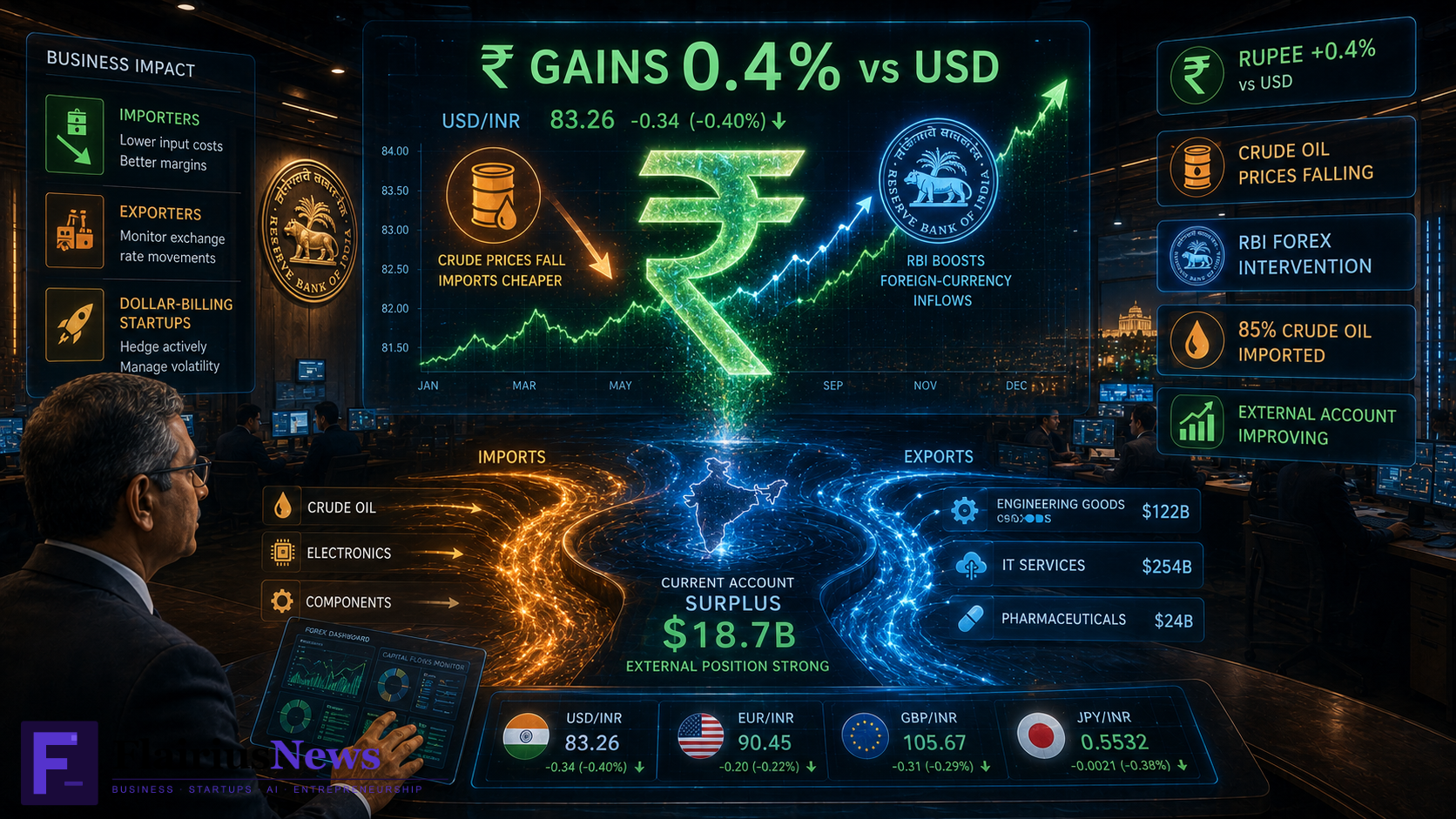
Currency movements are rarely front-page news. However, they quietly affect every business in India from a Bengaluru SaaS startup billing US clients in dollars to a Mumbai manufacturer importing components from China to a Jaipur exporter sending engineering goods to the EU.
On June 9, 2026, the rupee gained 0.4% against the dollar. Furthermore, two specific drivers caused this move. First, crude oil prices fell. Second, the RBI implemented measures to boost foreign-currency inflows. Consequently, concerns over India’s external balances eased and the rupee appreciated.
This is a meaningful signal. Moreover, it is part of a broader pattern in India’s currency trajectory in 2026.
What Drove the June Move
The rupee’s 0.4% gain came from two simultaneous forces working in the same direction. Therefore, the effect was amplified.
First, lower crude oil prices directly improve India’s current account. India imports approximately 85% of its crude oil. Consequently, every dollar decline in global oil prices reduces India’s import bill by hundreds of millions of dollars per month. Lower import costs reduce the demand for dollars, which supports the rupee.
Second, the RBI’s measures to boost foreign-currency inflows increase the supply of dollars in India’s foreign exchange market. Specifically, these measures typically include incentivising non-resident Indian deposits, facilitating foreign institutional investor inflows, and managing liquidity to attract carry trade flows.
Furthermore, both drivers reflect structural improvements rather than temporary interventions. Consequently, the rupee’s near-term outlook has improved.
What a Stronger Rupee Means for Different Businesses
However, currency direction affects different businesses differently. Therefore, understanding the impact requires clarity about which side of the trade a business sits on.
For importers: A stronger rupee is directly beneficial. Specifically, businesses that import raw materials, components, or finished goods manufacturers, electronics companies, pharmaceutical companies buying APIs face lower costs in rupee terms. Consequently, their input cost structures improve immediately.
For exporters: A stronger rupee creates a headwind. Specifically, engineering exporters, IT services companies, and garment manufacturers receive fewer rupees for the same dollar revenue. However, this is not necessarily catastrophic. India’s engineering exports grew 5% in FY26 despite currency movements. Furthermore, product quality and relationship depth typically matter more than 1–2% currency moves for established exporters.
For startups billing in dollars: A strengthening rupee reduces rupee revenues when dollar invoices are converted. Consequently, SaaS companies and IT services firms should monitor their hedging strategies carefully. However, a 0.4% single-day move is within normal volatility. What matters more is the medium-term trend.
For startups raising foreign capital: A stronger rupee is broadly positive. Specifically, it makes India-denominated costs salaries, office space, infrastructure relatively cheaper for foreign investors. Consequently, it marginally improves the economics of investing in Indian startups from a dollar perspective.

The Cotton Tariff Variable
Additionally, a separate development adds nuance. India’s cotton import-duty waiver may lower raw material costs for textile exporters. However, uncertainty over proposed US tariffs limits potential gains in that key market. Consequently, the textile sector faces a mixed picture domestic input cost relief, but export demand uncertainty.
This is a useful reminder. Currency is one factor. Trade policy is another. Furthermore, sector-specific demand conditions ultimately determine business outcomes more than macro-level currency moves.
The Practical Takeaway
Currency movements in India in 2026 reflect a fundamentally healthy external picture. Lower crude prices reduce India’s largest import cost. Furthermore, RBI’s proactive forex management maintains adequate reserves. Additionally, strong export performance in engineering provides sustained dollar inflows.
For founders and business leaders, the practical implication is this: India’s currency is not a source of major risk in 2026. However, it requires active monitoring. Furthermore, the businesses that manage currency exposure intelligently through natural hedging, multi-currency billing, or forward contracts will operate with more predictable economics than those that ignore it.
The rupee is not just a number. It is a signal about India’s economic health. Right now, that signal looks encouraging.
Tags: Indian Rupee 2026, Rupee Dollar Exchange Rate, RBI Forex Policy, India Crude Oil Impact, Currency Business India, Import Export Rupee, India External Balance, Forex India June 2026 Author CTA: Follow Flairius News — sharp takes on AI, business, and India’s startup economy — flairiusnews.com
 Aditya Agarwal
  Raghav Sharma