
 By Nayra Roy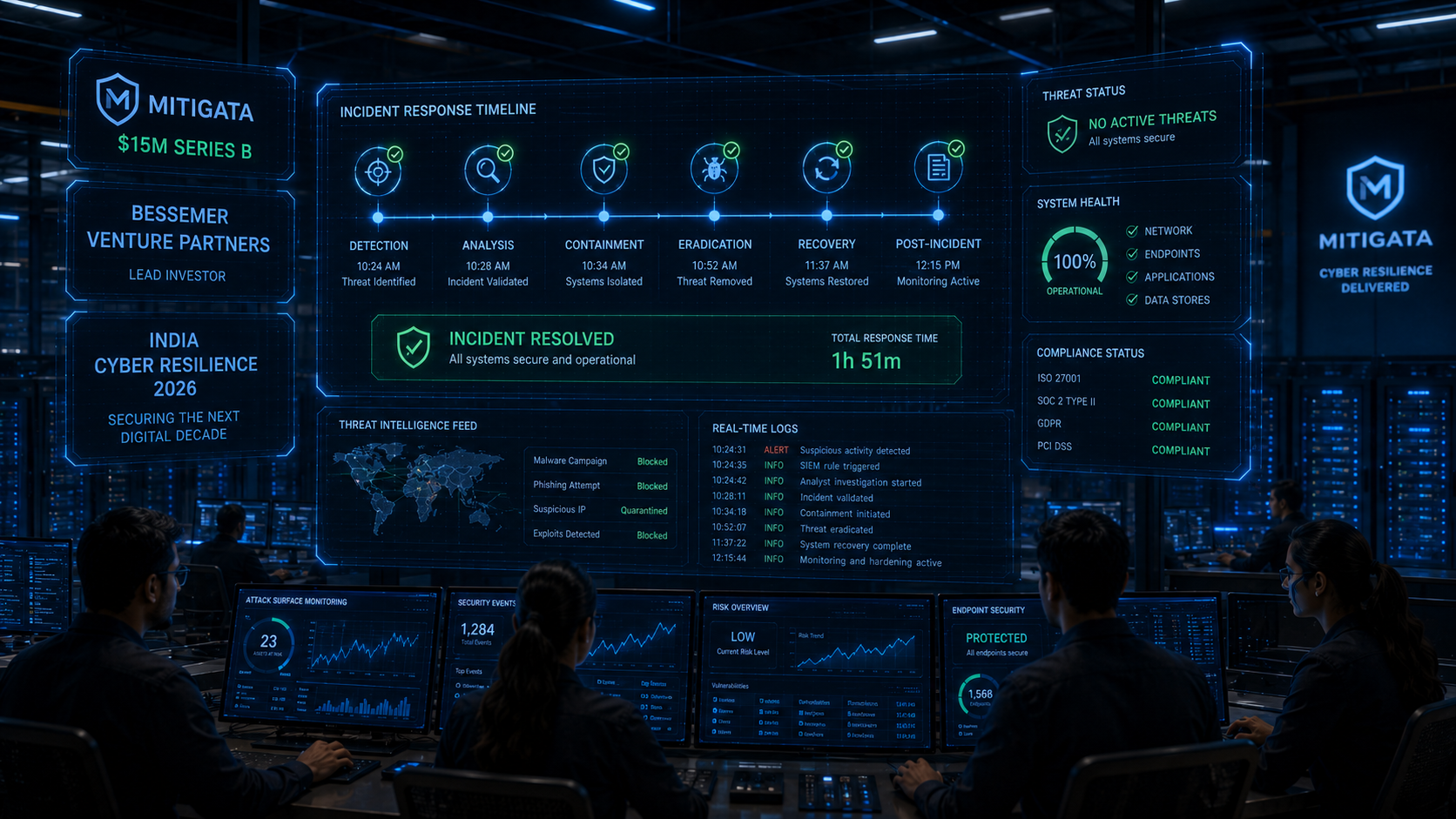
Indian enterprises are getting breached more often, and recovering from those breaches has become its own expensive specialty. Mitigata just raised serious capital to own that specialty.
On June 23, 2026, the same day Tata Electronics confirmed a ransomware breach exposing client files from Apple and Tesla, Bengaluru-based Mitigata closed a $15 million Series B led by Bessemer Venture Partners. Moreover, the timing was coincidental, but it could not have illustrated the company’s thesis more clearly.
Resilience, Not Just Prevention
Most cybersecurity startups focus on prevention stopping attacks before they happen. However, Mitigata positions itself around resilience: helping organisations respond, recover, and limit damage once a breach has already occurred. Specifically, that distinction matters enormously, since even the best prevention systems eventually fail against sophisticated, well-funded attackers.
Therefore, Mitigata’s value proposition sits closer to incident response, breach insurance coordination, and recovery playbooks than to traditional firewall or endpoint protection categories. Moreover, that positioning gives it a different, less crowded competitive lane than India’s broader cybersecurity startup field.
Why This Round Lands at the Right Moment
The Tata Electronics breach involving files reportedly linked to Apple and Tesla supply chain relationships is exactly the kind of high-profile incident that makes enterprise boards take cyber resilience budgets seriously. Consequently, Mitigata’s Series B arrives precisely when demand signals for its category are strengthening, not weakening.
Furthermore, Bessemer’s involvement brings global enterprise software investing experience to a sector that has historically been underserved by top-tier venture capital in India. Specifically, that signals growing institutional confidence that Indian cybersecurity startups can build globally competitive products, not just domestically-focused ones.
What the Capital Will Fund
Mitigata is expected to expand its incident response capabilities and deepen partnerships with insurers and enterprise risk teams. Moreover, as ransomware attacks against Indian manufacturing and technology companies continue rising, demand for structured, fast recovery playbooks should only grow.
The Bigger Pattern
This round fits neatly alongside the broader 2026 cybersecurity funding trend across India enterprise buyers increasingly treat breach response as core infrastructure, not an afterthought. Therefore, Mitigata’s bet on resilience over pure prevention may prove to be the more durable long-term business model, especially as breaches become a matter of when, not if.
Tags: Mitigata Funding, Bessemer Venture Partners India, India Cyber Resilience 2026, India Cybersecurity Startup, Bengaluru Startup Funding, Enterprise Breach Response India, Ransomware Recovery India Author CTA: Follow Flairius News — sharp takes on AI, business, and India’s startup economy — flairiusnews.com
 Ahana Verma