
 By Raghav Sharma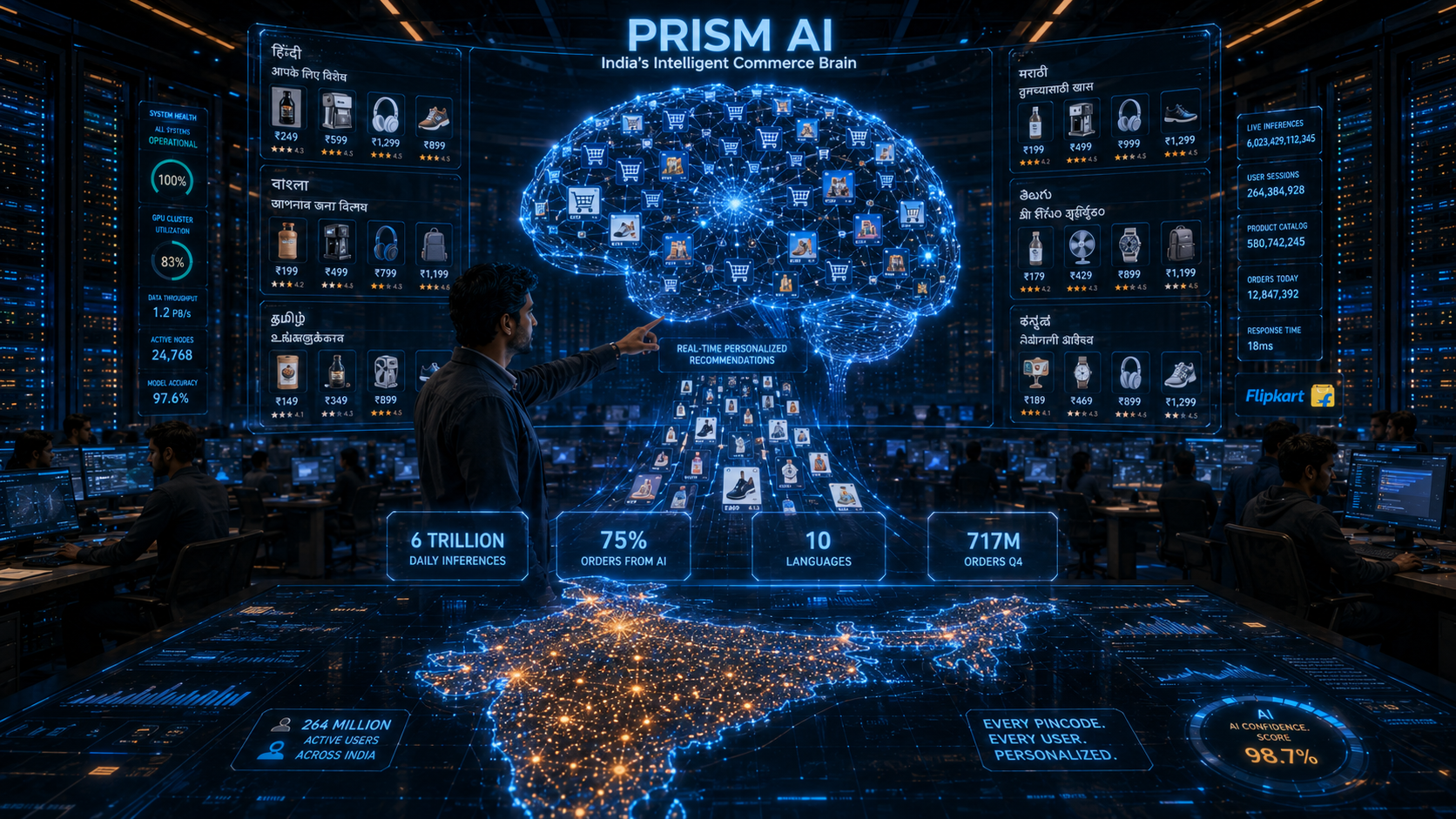
When India’s next hundred million internet users come online, most of them won’t type into a search bar. They’ll browse, tap, scroll, and discover the same way they shop in a local bazaar. Meesho built its AI system for exactly that reality.
This week, Meesho revealed the full details of PRISM Personalized Ranking & Intent Signal Module its proprietary AI intelligence architecture that has quietly become one of the most sophisticated commerce AI systems in the world. The headline number: more than 75% of orders on Meesho now originate from AI-driven personalized feeds powered by PRISM.
On a platform serving 264 million annual transacting users and recording 717 million placed orders in Q4 FY26, that is not a small claim. It is a fundamental reshaping of how Indian commerce works.
The Problem PRISM Was Built to Solve
Traditional e-commerce was designed around the search bar an interface that assumes users know exactly what they want and can articulate it in text. That assumption works reasonably well for urban, English-literate shoppers with specific purchase intent. It breaks down for a large part of India.
Much like shopping in a local bazaar, consumers on Meesho often browse, explore, and discover products rather than search with fixed intent. PRISM was built for this browsing-first behavior shifting commerce from keyword-led search to real-time intent understanding.
As Meesho’s Chief Data Scientist Debdoot Mukherjee put it: “The next hundred million Indians coming online will not search, they will discover.”
What PRISM Actually Does Under the Hood
At the core of PRISM is a real-time ranking and intelligence architecture that continuously analyses behavioural, transactional, and contextual signals across user journeys. The system operates through a network of more than 100 AI ranking models trained on over 400 trillion input signals and executes more than 6 trillion inferences daily within milliseconds.
To put that scale in perspective: 6 trillion daily inferences, spiking to 100 million inferences per second during peak traffic, is compute infrastructure at a level that rivals global technology companies. That Meesho built this in-house for the Indian market, on Indian infrastructure is itself a remarkable engineering achievement.
PRISM includes a component called Trendpulse, an LLM-powered layer that tracks regional purchase patterns and surfaces inventory matching local demand signals. The system supports voice-led navigation and regional dialects, covering more than 10 Indian languages including Hindi, Bengali, Marathi, Tamil, Telugu, Kannada, Malayalam, Gujarati, Punjabi, and Odia.
BharatMLStack: The Infrastructure Behind the Intelligence
Running 6 trillion daily inferences on conventional cloud infrastructure would be prohibitively expensive. To process these workloads, Meesho developed BharatMLStack, an in-house machine learning infrastructure platform built to support high-throughput AI workloads at significantly lower inference costs than conventional cloud infrastructure.
BharatMLStack is not just a cost-saving measure it is a strategic moat. By owning the infrastructure layer, Meesho can iterate faster, customise deeper, and avoid the vendor dependencies that constrain most Indian startups building on third-party cloud AI services.
This is exactly the kind of indigenous AI infrastructure investment that separates companies building a durable competitive advantage from those renting capabilities from abroad.
What This Means for Indian Ecommerce and Indian Founders
Meesho’s PRISM story is significant on two levels.
First, it demonstrates that AI-native commerce is not just a Western phenomenon. The assumption that sophisticated AI personalisation requires Western data sets, Western infrastructure, or Western users is wrong. PRISM works because it was built for the specific behavioural patterns, linguistic diversity, and browsing habits of Indian users not adapted from a system designed for someone else.
Second, it raises the bar for every ecommerce competitor in India. When 75% of orders come from AI-driven discovery rather than search, the platform that understands your intent better than you can articulate it wins. Flipkart, Amazon India, and every vertical commerce player in the country is now competing against that benchmark.
For founders building consumer-facing products in India in 2026, the Meesho PRISM playbook is essential reading: invest in your own ML infrastructure, build for discovery not search, and design for Bharat’s actual behaviour not a Western user’s.
Tags: Meesho, PRISM AI, BharatMLStack, Ecommerce AI India, Product Discovery, Indian AI Startup, Vernacular Commerce, AI Personalisation, Bharat Tech Author CTA: Follow Flairius News for sharp takes on AI, startups, and the future of business in India and beyond — flairiusnews.com
 Aditya Agarwal
  Nayra Roy