 By Raghav Sharma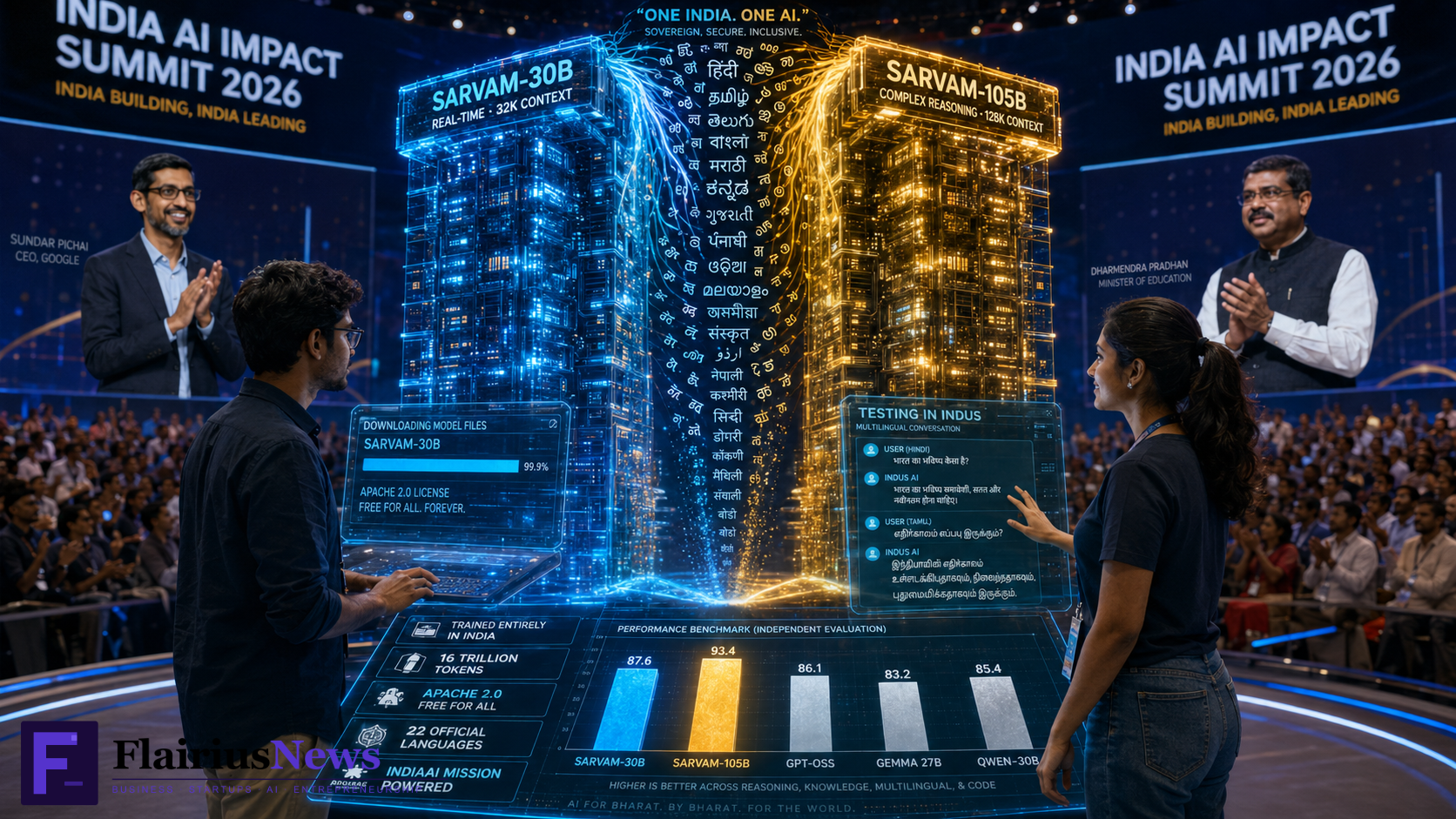
India has been waiting for this. For years, Indian developers, researchers, and enterprises built on top of models made abroad. They adapted foreign AI to Indian languages. They accepted latency penalties, data sovereignty risks, and products that never quite understood how Indians actually speak.
On February 18, 2026, that changed. Bengaluru-based Sarvam AI unveiled two foundational large language models Sarvam-30B and Sarvam-105B at the India AI Impact Summit in New Delhi. Furthermore, both models were trained entirely in India, from scratch, using computing power provided under the IndiaAI Mission. Moreover, they are available as open-source software under the Apache 2.0 licence. Consequently, any developer anywhere can download, use, and build on them for free.
Education Minister Dharmendra Pradhan called the launch “a defining moment in the country’s journey towards achieving self-reliance in full-stack AI infrastructure.” He was right.
What Sarvam-30B and Sarvam-105B Actually Are
The two models serve different purposes. Therefore, understanding each one separately matters.
Sarvam-30B is built for speed. It targets real-time conversational applications customer support, quick queries, voice-first interactions. Specifically, it uses a Mixture-of-Experts (MoE) architecture with one billion activated parameters. It was pre-trained on 16 trillion tokens and supports a 32,000-token context window. Furthermore, it performs competitively against global benchmarks including OpenAI’s GPT-OSS-20B, Google’s Gemma 27B, and Qwen-30B across mathematical reasoning, coding accuracy, and general problem-solving.
Sarvam-105B is built for depth. It handles complex reasoning, long-form tasks, coding, and advanced enterprise workflows. Specifically, it activates nine billion parameters per forward pass and supports a 128,000-token context window making it capable of processing entire documents, contracts, and research papers in a single context. Moreover, it is designed to compete against OpenAI’s GPT-OSS-120B and Alibaba’s Qwen-3-Next-80B. Additionally, it is already powering Indus Sarvam’s limited-beta AI assistant in early rollout.
Why Open-Source Under Apache 2.0 Matters
Many AI models are released with restrictive licences. Consequently, commercial use requires fees or compliance with complex terms. Sarvam chose Apache 2.0. As a result, any Indian startup, any researcher, any government department can use these models commercially without paying royalties or negotiating licences.
This is a strategic decision, not just a technical one. Specifically, it means Indian developers can build products on top of sovereign models without creating a new dependency on a foreign provider. Furthermore, it means the models improve faster because the global open-source community can contribute to them.
Additionally, the models are available for download on AIKosh and Hugging Face. Therefore, access is immediate and frictionless.
The Full Stack Sarvam Is Building
The LLMs are just one part of a broader platform. Sarvam is simultaneously building Sarvam Vision a 3B vision-language model for document intelligence across English and all 22 Indian languages. Moreover, it has released Saaras V3, a streaming speech model. Furthermore, Arya is its agent orchestration stack for enterprises.
Together, these form a complete Indian AI stack models, speech, vision, and agents all built natively for Indian languages and Indian deployment contexts. Consequently, an enterprise building an AI product for Indian customers can now use an entirely Indian technology foundation.
What This Means for Founders and Developers
For Indian developers, Sarvam’s release is the most practically important AI event of 2026. First, it provides a foundation for building products in Indian languages that no foreign model matches. Second, it removes the sovereignty risk that comes with sending sensitive Indian data to foreign AI platforms. Third, it offers a benchmark if your AI product needs to understand a Tamil farmer or a Gujarati shopkeeper, you now have a model built specifically to do that.
Furthermore, startups building on Sarvam’s open models can differentiate immediately. A customer support bot that genuinely understands Indian regional accents, code-switching, and cultural context is a different product from one adapted from an English-first model. That difference is commercially meaningful.
India built it from scratch. Now India gets to build on top of it.
Tags: Sarvam AI, Sarvam 30B, Sarvam 105B, India Sovereign LLM, Open Source AI India, IndiaAI Mission, Indian Language AI, Sarvam Indus, Mixture of Experts AI, Indian AI 2026 Author CTA: Follow Flairius News — sharp takes on AI, business, and India’s startup economy — flairiusnews.com
 Ahana Verma