 By Nayra Roy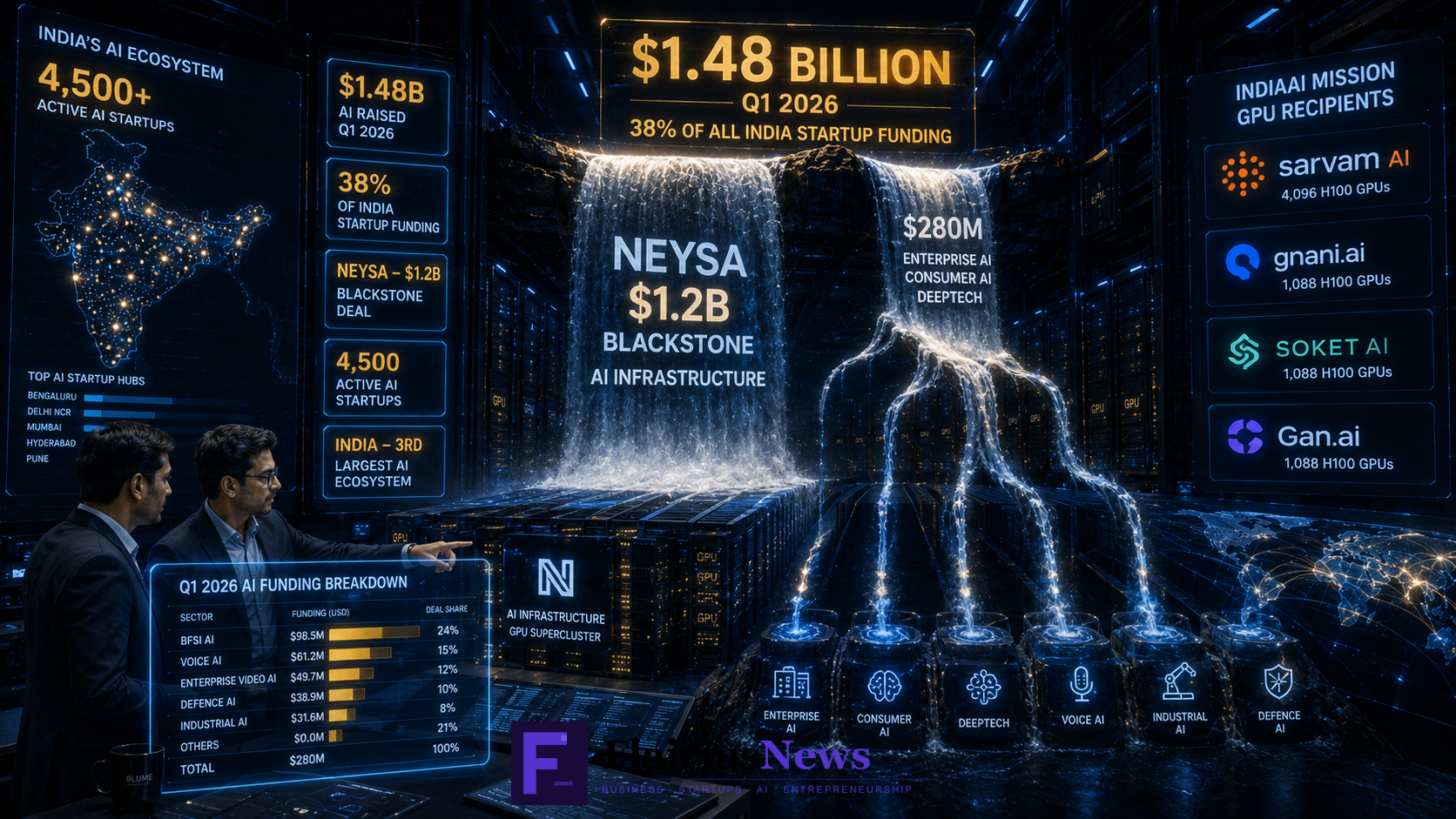
The Q1 2026 data is in. Furthermore, it tells a more specific story than the headline suggests.
India’s AI startups raised $1.48 billion in Q1 2026 alone. Moreover, AI-led companies attracted approximately 38% of India’s total $3.9 billion startup funding that quarter. Consequently, AI is no longer one sector among many in India’s startup economy. It is the dominant funding category.
However, one deal reshaped the entire quarter’s numbers. Neysa an Indian AI cloud startup secured a $1.2 billion financing from Blackstone. Therefore, without Neysa, the AI funding picture looks different. Understanding both versions of the story matters.
The Neysa Deal and Why It Changed Everything
Blackstone’s $1.2 billion equity investment in Neysa was the single largest AI infrastructure deal in India’s history. Furthermore, it reset expectations about how large India’s AI infrastructure bets can get.
Neysa plans to deploy over 20,000 GPUs for AI training creating compute infrastructure that Indian startups need but have historically been unable to access affordably. Consequently, the Neysa investment is not just a startup funding event. It is an infrastructure deployment that benefits the entire Indian AI ecosystem.
Additionally, Blackstone’s entry into Indian AI infrastructure signals global institutional conviction. Specifically, Blackstone manages over $1 trillion in assets globally. Its decision to deploy $1.2 billion into Indian AI compute signals that sovereign AI infrastructure is now considered a mainstream institutional asset class not just a venture bet.
What the Rest of Q1 2026 Looked Like
Strip out Neysa and the remaining AI startup funding in Q1 2026 was approximately $280 million across multiple companies and stages. Furthermore, this is still a strong quarter. Moreover, the sector diversity within that $280 million was healthy.
Enterprise AI attracted the largest share. Specifically, BFSI AI (Lumiq, HyperNorm AI), voice AI (Gnani.ai), and enterprise video AI (TrueFan AI) all raised meaningful rounds. Additionally, deeptech AI including defence AI and industrial AI companies from the SAP cohort secured capital from strategic investors.
Consumer AI also attracted capital. Moreover, the Kuku FM trajectory ₹1,400 crore revenue in FY26, IPO filing imminent validated consumer AI as a commercial category in India, not just a product experiment.
India’s 4,500 AI Startups What the Ecosystem Looks Like
India now has over 4,500 active AI startups, ranking third globally after the United States and China. Furthermore, the IndiaAI Mission has selected four companies to receive government-backed compute support for foundational model development: Sarvam AI (4,096 NVIDIA H100 GPUs), Gnani.ai, SoketAI, and Gan.ai.
Moreover, the ecosystem has matured structurally. Specifically, the previous generation of Indian AI startups built primarily on top of OpenAI’s API creating applications without developing proprietary model capabilities. The current generation is different. Sarvam’s open-source 30B and 105B models, Krutrim’s V2 LLM, and Neysa’s GPU infrastructure are all building the foundational layers that reduce dependency on foreign AI platforms.
Additionally, the IPO pipeline signals ecosystem maturity. Fractal Analytics already listed. Furthermore, OYO and Kuku FM are in the queue. Consequently, the exit infrastructure that early-stage investors need to justify continued commitment to Indian AI is beginning to materialise.
The Founder Opportunity Within the Q1 Data
For Indian founders, the Q1 2026 data points toward two specific opportunities. First, infrastructure-adjacent AI. Companies that sit one layer above the GPU providing model evaluation tools, fine-tuning services, data pipelines, and deployment infrastructure benefit from the compute buildout without needing to fund it themselves.
Second, vertical AI for India’s underserved sectors. The Q1 funding went to healthcare AI (Qure.ai), financial risk AI (Privue, HyperNorm), and industrial AI (Drishya AI, ANSCER Robotics). Therefore, sector-specific AI with defensible data moats and clear enterprise buyers attracted capital reliably. Horizontal AI tools did not.
The $1.48 billion quarter was not evenly distributed. However, the pattern of where it went is a clear signal of where serious capital continues to flow in India’s AI ecosystem in 2026.
Tags: India AI Funding Q1 2026, Neysa Blackstone, AI Infrastructure India, India AI Startups, IndiaAI Mission GPU, Sarvam AI, Fractal Analytics, AI Startup Capital India 2026 Author CTA: Follow Flairius News — sharp takes on AI, business, and India’s startup economy — flairiusnews.com
 Aditya Agarwal
  Raghav Sharma