
 By Raghav Sharma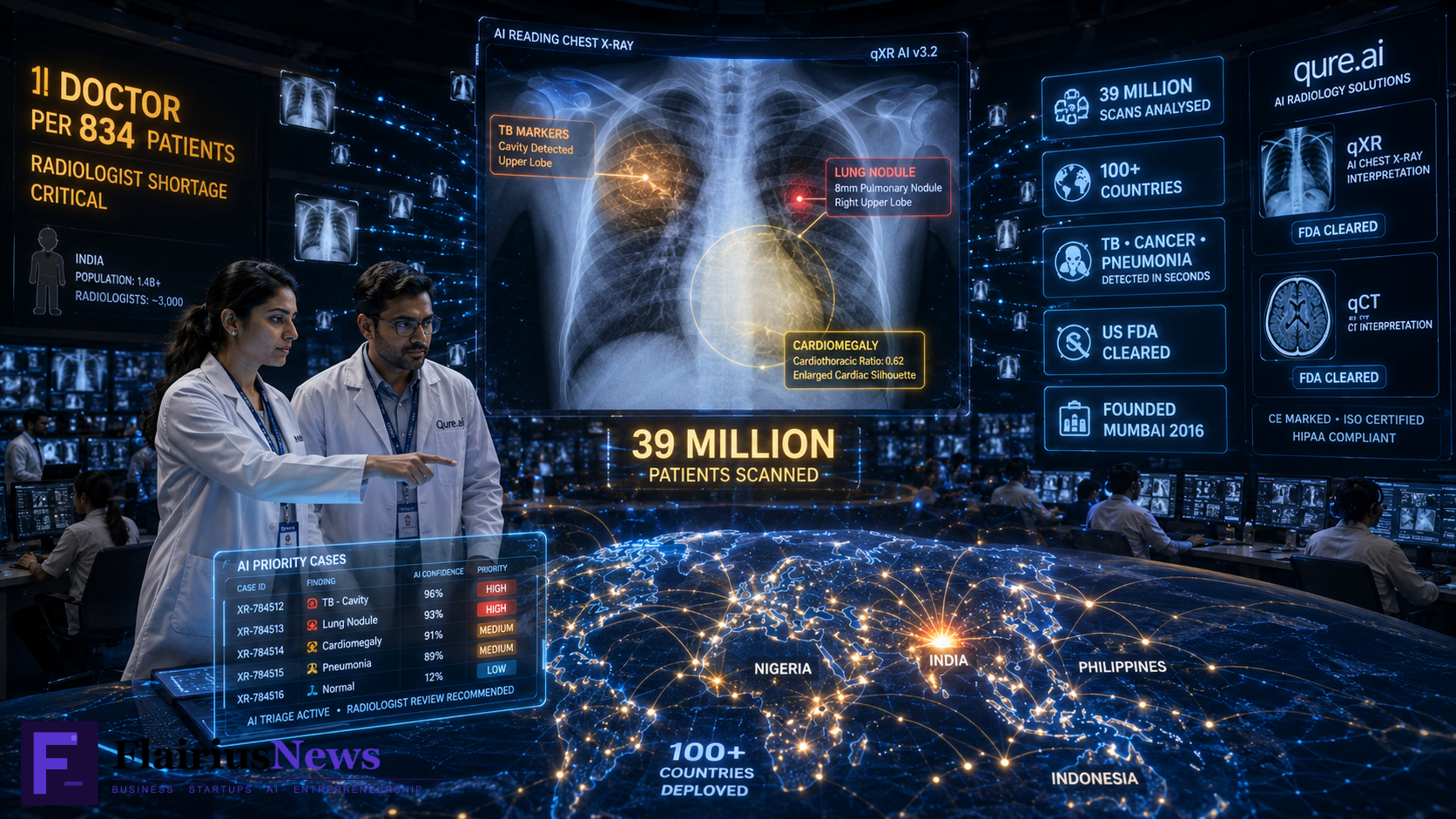
India has a doctor shortage. It is not subtle. Furthermore, it is structural. The country has approximately one doctor per 834 people. Moreover, radiologists the specialists who read CT scans, X-rays, and MRIs are concentrated in cities. Consequently, patients in Tier 2 towns and rural areas wait days or weeks for a scan result that could determine whether they have TB, cancer, or a brain bleed.
Qure.ai does not solve the doctor shortage. However, it multiplies what each doctor can do. Specifically, its AI reads medical imaging scans chest X-rays, CT scans, and MRIs at a speed and accuracy that no human radiologist can sustainably match.
The result is a number that has no precedent in Indian health AI: 39 million patient scans analysed. Furthermore, the platform now operates across more than 100 countries. Consequently, a Mumbai-founded startup has become the world’s leading AI radiology platform by volume.
What Qure.ai Actually Builds
Qure.ai was founded in 2016 by Prashant Warier and Pooja Rao. The company builds AI tools specifically for radiology and clinical imaging. Its flagship products include qXR an AI chest X-ray reader and qCT for CT scan analysis.
The AI identifies findings such as tuberculosis, pneumonia, lung nodules, COVID-19 pneumonia, pleural effusion, and cardiomegaly automatically, in seconds, from a digital X-ray image. Furthermore, it integrates directly into existing radiology workflows and PACS systems. Therefore, a radiologist using Qure.ai does not change how they work. They simply see results faster, with AI flagging priority cases for immediate attention.
Additionally, the platform works in low-resource environments. Specifically, it performs well on images from older, lower-quality imaging equipment the kind found in government hospitals across India, Africa, and Southeast Asia. Consequently, its impact is greatest precisely where doctor shortages are most acute.
The Scale Behind the 39 Million Number
Thirty-nine million scans is not a marketing figure. It is a training signal. Every scan that Qure.ai analyses with radiologist validation strengthens its model’s ability to detect edge cases, rare conditions, and subtle imaging findings. Moreover, it builds a dataset that no competitor starting today can replicate quickly.
Furthermore, the geographic diversity of those 39 million scans is itself an advantage. TB presentations on a chest X-ray look different across populations with different genetic backgrounds, nutritional statuses, and disease histories. Therefore, a model trained on Indian, African, Southeast Asian, and Latin American scans outperforms one trained primarily on Western clinical data. Qure.ai’s dataset is inherently diverse.
The Path to 100 Countries
The 100-country presence reflects deliberate geographic strategy. Qure.ai entered markets where the combination of imaging hardware penetration and radiologist shortage was highest creating the clearest case for AI augmentation.
Specifically, the company has deep penetration in India, Nigeria, the Philippines, Indonesia, and several Latin American markets. Moreover, it has deployed in partnership with national TB programmes and large hospital chains. Consequently, its commercial model spans both direct enterprise sales and government programme partnerships.
Additionally, Qure.ai received US FDA clearance for several of its products a critical credential that unlocks not just the US market but also a credibility signal for large institutional buyers globally. Therefore, the FDA clearance is both a commercial unlock and a quality validation.
Why India’s Health AI Story Is Just Beginning
India’s healthcare sector is enormous, underdigitised, and genuinely in need of AI augmentation. Furthermore, the government’s Ayushman Bharat programme covering 500 million Indians creates a public procurement pathway for health AI that barely existed five years ago.
Qure.ai is the template for what Indian health AI can look like when it is built on genuine clinical validation, global regulatory approval, and a dataset large enough to sustain technical moats. For the next generation of Indian health AI founders, the question is not whether the opportunity exists. The 39 million scans answer that. The question is which specific clinical problem to solve with the same rigour.
Tags: Qure.ai, AI Radiology India, Health AI Startup, 39 Million Patient Scans, India AI Healthcare, Global AI Health, Prashant Warier, AI Medical Imaging, India HealthTech 2026 Author CTA: Follow Flairius News — sharp takes on AI, business, and India’s startup economy — flairiusnews.com
 Aditya Agarwal
  Nayra Roy